Translate

Thursday, 13 August 2015

Helix cincta (O.F. Muller, 1774) - Cyprus

Helix cincta is a species of gastropods belonging to the family Helicidae.

Taxonomy
Helix cincta is related to several other Helix species with brown shell aperture margins (Helix borealis, Helix melanostoma, Helix pronuba, etc.). Among these, it is part of a group of closely related species that includes also Helix anctostoma and Helix valentini. So far, it is not clear how well are these two separated from H. cincta, or if they rather represent extremes of its conchological variation.

Helix anctostoma has been originally described from the Belen Pass in the Hatay Province of Turkey, and is characterised by a knob on the columellar aperture margin. However, such knob sometimes occurs in European H. cincta as well. Recently, forms with more flattened shells occurring by the Turkish-Syrian frontier were also classified as H. anctostoma.

Helix valentini has been described from an east-Aegean island, but naturally occurs in the Hatay province and northwestern Syria (known as Helix antiochiensis). It has a larger, more conical shell; often there are fine whitish spots in the brown spiral bands.

Distribution
The current distribution is disjunctive, with four separated areas of occurrence. The species originates from Syria or adjacent Turkey, it is most likely introduced in all other parts of its range. These are Cyprus, western Anatolia and eastern Aegean islands, and northeastern Italy with the northern Adriatic coast up to Dalmatia. From Wikipedia, the free encyclopedia
Photos Akanthou by George Konstantinou

                                                                        Helix cincta Leucistic Specimen


Helix chasiana Pallary, 1899 - Εndemic to Cyprus

Photos Nicosia by George Konstantinou

Eobania vermiculata or Helix vermiculata (O. F. Müller, 1774) - Cyprus

Eobania vermiculata also known as Helix vermiculata, common name the "chocolate-band snail" is a species of large, air-breathing, land snail, a terrestrial pulmonate gastropod mollusk in the family Helicidae, the true snails or typical snails.
Eobania vermiculata is the type species of the genus Eobania.
Eobania vermiculata live in a broad variety of habitats, usually in dry vegetation, mainly in coastal vicinity, also in agricultural crops. It is very common in Crete, the species lives on practically every small island in the south Aegean
 In northern Greece copulation takes place after the first rainfalls in autumn. These snails create and use love darts as part of their mating behavior. Around 70 eggs per snail are laid 20 days later. The size of the egg is 4.1 × 3 mm.[8] Juveniles hatch shortly after and grow about 12–13 mm in diameter per year for 2 years (growth is usually restricted to February to June in northern Greece, in Crete this period ends already in May). Maturity is reached after 2 years when the diameter reaches 25 mm, the umbilicus becomes closed and the apertural margin becomes reflected. Snails reach 29–30 mm diameter in May/June of the second year in northern Greece (in April in Crete), reaching a maximum diameter (33 mm) may take 5 years or more, but mortality increases greatly after 2 years
About 20% of the snails in a population survive to lay eggs in the 3rd year, 5% of the snails lay eggs again in the 4th year. The mortality rates decrease with age. The animals hibernate (in northern Greece) or aestivate (in Crete), but juveniles and adults show differences in their behaviour. Adults dig into the soil and build an epiphragm, while juveniles search protected places under stones or leaves of low plants
The species is used for food. It is commercialized and exported from Greece to France, which led Lazaridou-Dimitriadou & Kattoulas (1981) to propose restrictions on the size and seasons of collection for this species. From Wikipedia, the free encyclopedia
Photos Nicosia by George Konstantinou


Elia moesta (Rossmässler, 1839). - Cyprus

 Family Clausiliidae

Elia is a genus of gastropods belonging to the family Clausiliidae.

The species of this genus are found in Eastern Mediterranean and near Black Sea

See also

List of non-marine molluscs of Cyprus - Freshwater snails and Land snails of Cyprus

Photos Pafos by George Konstantinou


Cochlicella barbara (Linnaeus,1758) - Cyprus

Cochlicella barbara is a species of small but very high-spired, air-breathing land snail, a pulmonate gastropod mollusk in the family Geomitridae
This species is native to Europe. It occurs, mostly on the coast, from north Portugal to the northwestern Mediterranean area. It has been widely introduced in other countries in the same general area, including England and Wales.
This is also an introduced species in Australia. From Wikipedia, the free encyclopedia
Photos Nicosia by George Konstantinou


Pointed snail - Cochlicella acuta (O. F. Müller, 1774) - Cyprus

Cochlicella acuta, common name the pointed snail, is a species of small but very high-spired, air-breathing land snail, apulmonate gastropod mollusk in the family Geomitridae. 
Previously however, Cochlicella was placed in the Helicidae or the Hygromiidae instead.
This species is native to parts of Europe. It inhabits south-western Europe including Spain, and western Europe including France,Belgium, Netherlands and the British Isles.In the British Isles it lives in dunes, sandhills, and grassy downs close to the sea, chiefly in the south and west of England, Wales, on islands off the west coast of Scotland, and along the Irish coast. It is extremely abundant in some areas. The species has been introduced in the eastern Mediterranean, including Greece, Israel and Egypt.
It has also been introduced to Australia, where it has become a problematic invasive, or pest species
This species does well on sandy calcareous soils, and often prefers a coastal setting such as sand dunes. It aestivates by attaching itself to vertical surfaces such as fence posts, tall weeds and so on.
Cochlicella acuta is an intermediate host for the terrestrial trematode parasite Brachylaima cribbi
From Wikipedia, the free encyclopedia
Photos Geri by George Konstantinou

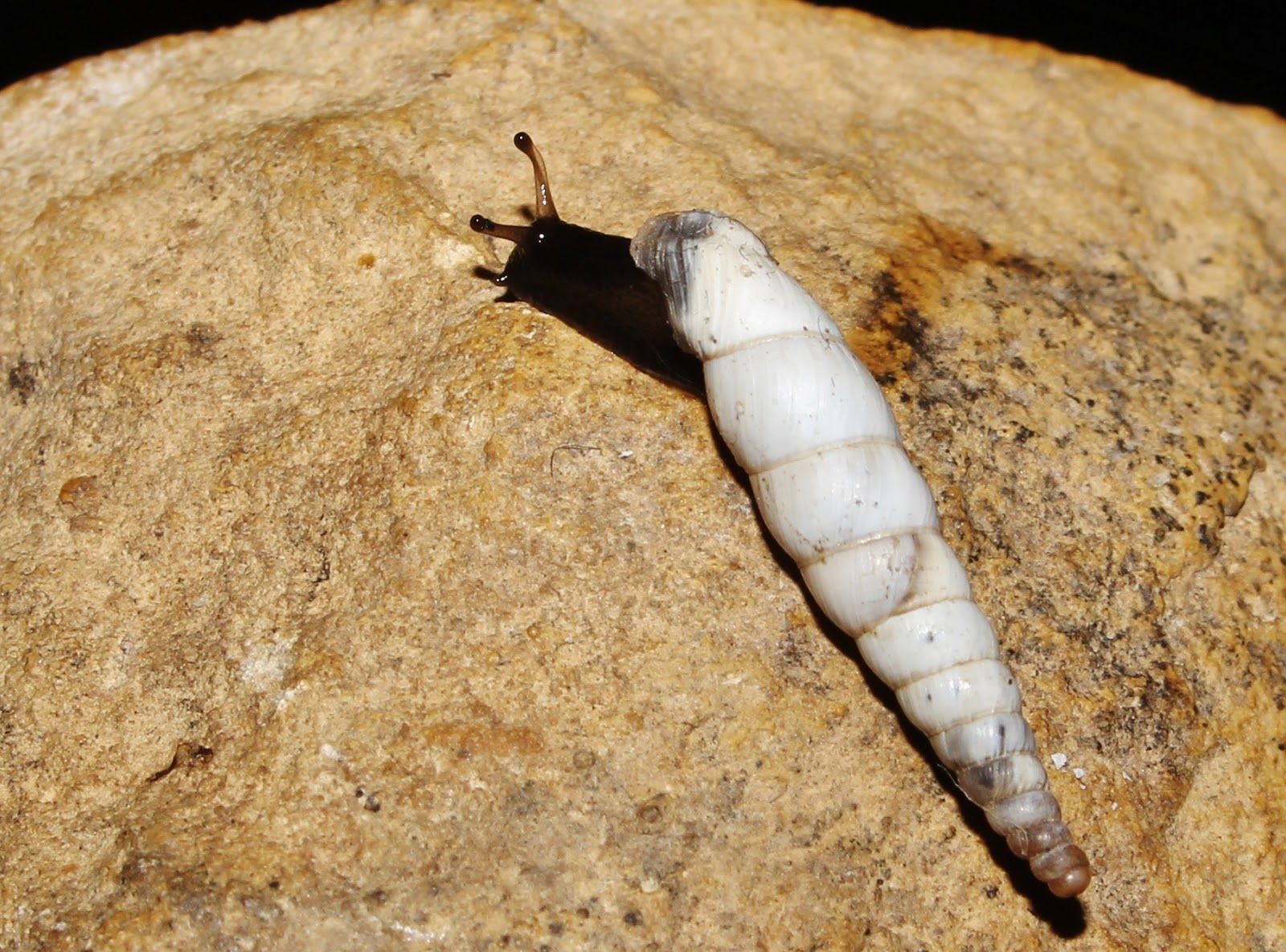
Albinaria saxatilis saxatilis (Pfeiffer, 1846) - Endemic to Cyprus

Endemic to Cyprus

Albinaria is a genus of air-breathing land snails, terrestrial pulmonate gastropod mollusks in the family Clausiliidae, the door snails.

Ecology and Life Cycle
The snails live on limestone rocks, where they feed on algae and lichen. They are active only during the wet season, that is, in Mediterranean lowlands, from November through April. Eggs are laid shortly after the beginning of the wet season. The development from a juvenile to a fully grown shell takes two to three wet seasons. During the intermittent dry seasons, the snails, young and adults alike, aestivate ("the warm weather equivalent of hibernation") on the rocks or in crevices inside the rocks. For aestivation, aggregates are often formed, sometimes reaching sizes of many hundreds of individuals. During the last dry season prior to sexual maturation, the subadult snail (the shell of which is already fully developed, albeit thinner than that of an adult) increases the size of its genital organs. Copulation then takes place during the first weeks of autumn rains. Population densities can sometimes be very high, in spite of heavy predation by beetle larvae of the genus Drilus. These insects attack the snails during their aestivation, by perforating the shell and eating the snail inside

Photos Akamas by George Konstantinou


Green garden snail - Cornu aspersum or Cantareus aspersus (Müller, 1774) - Cyprus

Cantareus apertus, commonly known as the green garden snail, is a species of air-breathing land snail, a terrestrial pulmonate gastropod mollusc in the family Helicidae, the typical snails.

Distribution

Cantareus apertus is native to Europe primarily near the Mediterranean Sea, and also North Africa

See also

List of non-marine molluscs of Cyprus - Freshwater snails and Land snails of Cyprus

.Photos Nicosia by George Konstantinou


Albinaria virgo (Mousson, 1854) - Endemic to Cyprus and Pentadaktylos mountain

Endemic to Cyprus
Albinaria virgo ενδημικά χερσαία σαλιγκάρια της Κύπρου που το συναντούμε μόνο στην οροσειρά του κατεχόμενου πενταδάκτυλου 

Albinaria is a genus of air-breathing land snails, terrestrial pulmonate gastropod mollusks in the family Clausiliidae, the door snails.

Ecology and Life Cycle
The snails live on limestone rocks, where they feed on algae and lichen. They are active only during the wet season, that is, in Mediterranean lowlands, from November through April. Eggs are laid shortly after the beginning of the wet season. The development from a juvenile to a fully grown shell takes two to three wet seasons. During the intermittent dry seasons, the snails, young and adults alike, aestivate ("the warm weather equivalent of hibernation") on the rocks or in crevices inside the rocks. For aestivation, aggregates are often formed, sometimes reaching sizes of many hundreds of individuals. During the last dry season prior to sexual maturation, the subadult snail (the shell of which is already fully developed, albeit thinner than that of an adult) increases the size of its genital organs. Copulation then takes place during the first weeks of autumn rains. Population densities can sometimes be very high, in spite of heavy predation by beetle larvae of the genus Drilus. These insects attack the snails during their aestivation, by perforating the shell and eating the snail inside
Photos Lapithos by George Konstantinou