Translate

Saturday, 1 August 2015

Laughing dove or palm dove and Senegal dove - Streptopelia senegalensis (Linnaeus, 1766) - Φοινικοτρύγονο, Φοινικοπερίστερο - Cyprus

Το φοινικοτρύγονο είναι είδος τρυγονιού που εξαπλώνεται στην Υποσαχάρια Αφρική, τη Μέση Ανατολή και την Ινδική υποήπειρο. Στην Κύπρο το φοινικοτρύγονο θεωρείται τυχαίος επισκέπτης και τα τελευταία χρόνια άρχισε να εποικίζει τον τόπο μας με γοργούς ρυθμούς. Το συναντούμε κυρίως σε κατοικημένες περιοχές και φωλιάζει συνήθως σε δέντρα σε κήπους σπιτιών με προτιμήσει τα γνωστά μας Γιούκα με τα πυκνά φυλλώματα. Την γρήγορη του εξάπλωση την οφείλει στο γεγονός ότι αναπαράγετε αρκετές φορές τον χρόνο ακόμα και στην καρδιά του χειμώνα. Είναι ένα πολύ φιλικό είδος με τον άνθρωπο και πλησιάζετε εύκολα και για αυτό την εποχή του κυνήγιού δυστυχώς αποδεκατίζονται από τους κυνηγούς.
Γιώργος Κωνσταντίνου

The laughing dove (Streptopelia  senegalensis) is a small pigeon that is a resident breeder in Sub-Saharan Africa, the Middle East east to the Indian Subcontinent. This small long-tailed dove is found in dry scrub and semi-desert habitats where pairs can often be seen feeding on the ground. A rufous and black chequered necklace gives it a distinctive pattern and is also easily distinguished from other doves by its call. Other names include palm dove and Senegal dove while in India the name of the little brown dove is often used. It was introduced in Western Australia and has established itself in the wild around Perth and Fremantle.
It is a common and widespread species in scrub, dry farmland and habitation over a good deal of its range, often becoming very tame. The species is found in much of Sub-Saharan Africa, Saudi Arabia, Iran, Afghanistan, Pakistan and India. It is also found in Israel, Lebanon, Syria, the UAE and Turkey (these populations may be derived from human introductions). They are mostly sedentary but some populations may make movements. Birds ringed in Gujarat have been recovered 200 km north in Pakistan and exhausted birds have been recorded landing on ships in the Arabian Sea. The species (thought to belong to the nominate population) was introduced to Perth in 1889 and has become established around Western Australia. Birds that land on ships may be introduced to new regions.
The species is usually seen in pairs or small parties and only rarely in larger groups. Larger groups are formed especially when drinking at waterholes in arid regions. Small numbers assemble on trees near waterholes before flying to the water's edge where they are able to suck up water like other members of the pigeon family. Laughing doves eat the fallen seeds, mainly of grasses, other vegetable matter and small ground insects such as termites and beetles. They are fairly terrestrial, foraging on the ground in grasslands and cultivation. Their flight is quick and direct with the regular beats and an occasional sharp flick of the wings which are characteristic of pigeons in general.  From Wikipedia, the free encyclopedia
Photos Zakaki , Aradippou by George Konstantinou


Short-toed treecreeper (Certhia brachydactyla dorotheae) (Brehm,1820) Δεντροβάτης - Endemic Subspecies of Cyprus.


The short-toed treecreeper (Certhia brachydactyla) is a small passerine bird found in woodlands through much of the warmer regions of Europe and into north Africa. It has a generally more southerly distribution than the other European treecreeper species, the common treecreeper, with which it is easily confused where they both occur. The short-toed treecreeper tends to prefer deciduous trees and lower altitudes than its relative in these overlap areas. Although mainly sedentary, vagrants have occurred outside the breeding range.
The short-toed treecreeper is one of a group of four very similar Holarctic treecreepers, including the closely related North American brown creepers, and has five subspecies differing in appearance and song. Like other treecreepers, the short-toed is inconspicuously plumaged brown above and whitish below, and has a curved bill and stiff tail feathers. It is a resident in woodlands throughout its range, and nests in tree crevices or behind bark flakes, laying about six eggs. This common, unwary, but inconspicuous species feeds mainly on insects which are picked from the tree trunk as the treecreeper ascends with short hops.
The Short-toed nests in tree crevices or behind bark flakes. Old woodpecker nests, crevices in buildings or walls, and artificial nest boxes or flaps are also used.
The nest has an often bulky base of twigs, pine needles, grass or bark, and a lining of finer material such as feathers, wool, moss, lichen or spider web. The eggs are laid between April and mid June (typical clutch 5–7 eggs); they are white with purple-red blotches, 15.6 x 12.2 mm (0.6 x 0.5 in) in size. The eggs are incubated by the female alone for 13 – 15 days until the altricial downy chicks hatch; they are then fed by both parents, but brooded by the female alone, for a further 15 – 18 days to fledging. This species often raises a second brood. The male starts constructing a new nest while the female is still feeding the first brood, and when the chicks are 10–12 days old, he takes over feeding duties while the female completes the new nest.
A Spanish study suggests that forest fragmentation adversely affects the numbers of short-toed treecreepers present, as is also the case with the common treecreeper. Species that depend on relatively scarce resources, such as tree trunks, only occupy the larger forests, whereas those such as tits and common firecrests that exploit abundant, ubiquitous resources are distributed uniformly through woodlands of all sizes
The short-toed treecreeper typically seeks invertebrate food on tree trunks, starting near the tree base and spiralling its way up using its stiff tail feathers for support. Unlike a nuthatch, it does not come down trees head first, but flies to the base of another nearby tree. It uses its long thin bill to extract insects and spiders from crevices in the bark. Although normally found on trees, it will occasionally feed on walls or bare ground, or amongst fallen pine needles. It may add some seeds to its diet in the colder months. From Wikipedia, the free encyclopedia
Photos Troodos by George Konstantinou


Lesser Whitethroat (Sylvia curruca) (Linnaeus, 1758) Βουνοτσιροβάκος - Συκαλλίδι - Λαλοτσιροβάκος - Cyprus


The lesser whitethroat (Sylvia curruca) is a common and widespread typical warbler which breeds in temperate Europe, except the southwest, and in western and central Asia. This small passerine bird is strongly migratory, wintering in Africa just south of the Sahara,Arabia and India.
Unlike many typical warblers, the sexes are almost identical. This is a small species with a grey back, whitish underparts, a grey head with a darker "bandit mask" through the eyes and a white throat. It is slightly smaller than the whitethroat, and lacks the chestnut wings and uniform head-face color of that species. The lesser whitethroat's song is a fast and rattling sequence of tet or checalls, quite different from the whitethroat's scolding song.
Like most "warblers", it is insectivorous, but will also take berries and other soft fruit. This is a birdof fairly open country and cultivation, with large bushes for nesting and some trees. The nest is built in low shrub or brambles, and 3–7 eggs are laid. From Wikipedia, the free encyclopedia
Photos and video  25 of March 2016 at Cape Greco by George Konstantinou


Subalpine warbler (Sylvia cantillans) (Pallas, 1764, Italy) Κοκκινοτσιροβάκος - Cyprus


The subalpine warbler (Sylvia cantillans) is a small typical warbler which breeds in the southernmost areas of Europe and northwest Africa. This small passerine bird is migratory, and winters along the southern edge of the Sahara. It occurs as a vagrant well away from the breeding range, in both spring and autumn as far north as Great Britain.
Like most Sylvia species, it has distinct male and female plumages. The adult male has a grey back and head, brick-red underparts, and white malar streaks ("moustaches"). The female is mainly brown above, with a greyer head, and whitish below with a pink flush. The subalpine warbler's song is fast and rattling, and is similar to the lesser whitethroat.
This bird seems to be related to the Sardinian warbler-Menetries' warbler superspecies. They all have white malar areas, the heads being dark above in adult males, and naked eye-rings. These three species are related to a superspecies consisting of Rüppell's warbler and the Cyprus warbler, which also share the white malar area with blackish above.(Shirihai et al. 2001, Jønsson & Fjeldså 2006 ) The subalpine warbler is divided into three distinct subspecies groups, which may possibly be sufficiently diverged to qualify as three separate species (Shirihai et al. 2001). The three groups have differing male plumages, distinctive calls, and are allopatric; further study is needed. From Wikipedia, the free encyclopedia
Photos Meneou by George Konstantinou

Merlin (Falco columbarius) Linnaeus, 1758 - Νανογέρακο - Cyprus

See also

List of Cyprus birds of prey on this blog - Λίστα Αρπαχτικών πουλιών της Κύπρου σε αυτό το ιστολόγιο

 - Αρπαχτικά πουλιά της Κύπρου

The merlin (Falco columbarius) is a small species of falcon from the Northern Hemisphere. A bird of prey once known colloquially as apigeon hawk in North America, the merlin breeds in the northern Holarctic; some migrate to subtropical and northern tropical regions in winter.
Merlins inhabit fairly open country, such as willow or birch scrub, shrubland, but also taiga forest, parks, grassland such as steppe and prairies, or moorland. They are not very habitat-specific and can be found from sea level to the treeline. In general, they prefer a mix of low and medium-height vegetation with some trees, and avoid dense forests as well as treeless arid regions. During migration however, they will utilize almost any habitat.
Most of its populations are migratory, wintering in warmer regions. Northern European birds move to southern Europe and North Africa, and North American populations to the southern USA to northern South America. In the milder maritime parts of its breeding range, such as Great Britain, the Pacific Northwest and western Iceland, as well as in Central Asia, it will merely desert higher ground and move to coasts and lowland during winter. The migration to the breeding grounds starts in late February, with most birds passing through the USA, Central Europe and southern Russia in March and April, and the last stragglers arriving in the breeding range towards the end of May. Migration to winter quarters at least in Eurasia peaks in August/September, while e.g. in Ohio, just south of the breeding range, F. c. columbarius is typically recorded as a southbound migrant as late as September/October
.From Wikipedia, the free encyclopedia
Photos Akrotiri by George Konstantinou

Barred Warbler (Sylvia nisoria) (Bechstein, 1792) - Γερακοτσιροβάκος - Cyprus


The barred warbler (Sylvia nisoria) is a typical warbler which breeds across temperate regions of central and eastern Europe and western and central Asia. This passerine bird is strongly migratory, and winters in tropical eastern Africa
It is the largest Sylvia warbler, 15.5–17 cm in length and weighing 22–36 g, mainly grey above and whitish below. Adult males are dark grey above with white tips on the wing coverts and tail feathers, and heavily barred below. The female is similar but slightly paler and has only light barring. Young birds buffy grey-brown above, pale buff below, and have very little barring, with few obvious distinctive features; they can easily be confused with garden warblers, differing in the slight barring on the tail coverts and the pale fringes on the wing feathers, and their slightly larger size. The eye has a yellow iris in adults, dark in immatures; the bill is blackish with a paler base, and the legs stout, grey-brown.
The barred warbler is a bird of open country with bushes for nesting, with very similar habitat preferences to the red-backed shrike. The nest is built in low shrub or brambles, and three to seven eggs are laid. Like most warblers, it is mainly insectivorous, but also takes berries and other soft fruit extensively in late summer and autumn. Its song is a pleasant chattering like a garden warbler with many clear notes, but is harsher and less melodious, and slightly higher pitched, with some resemblance to the whitethroat's song. From Wikipedia, the free encyclopedia
Photos Geri by George Konstantinou

Eurasian crag martin or just Crag martin - (Ptyonoprogne rupestris) (Scopoli, 1769) - Βραχοχελίδονο - Cyprus

See also 

Τα 5 είδη χελιδονιών της Κύπρου (WEB TV) - Του Γιώργου Κωνσταντίνου - Εφημερίδα πολίτης 11/6/2018

The Eurasian crag martin or just crag martin (Ptyonoprogne rupestris) is a small passerine bird in the swallow family. It is about 14 cm (5.5 in) long with ash-brown upperparts and paler underparts, and a short, square tail that has distinctive white patches on most of its feathers. It breeds in the mountains of southern Europe, northwestern Africa and southern Asia. It can be confused with the three other species in its genus, but is larger than both, with brighter tail spots and different plumage tone. Many European birds are resident, but some northern populations and most Asian breeders are migratory, wintering in northern Africa, the Middle East or India.
The Eurasian crag martin builds a nest adherent to the rock under a cliff overhang or increasingly onto a man-made structure. It makes a neat half-cup mud nest with an inner soft lining of feathers and dry grass. Nests are often solitary, although a few pairs may breed relatively close together at good locations. Two to five brown-blotched white eggs are incubated mainly by the female, and both parents feed the chicks. This species does not form large breeding colonies, but is gregarious outside the breeding season. It feeds on a wide variety of insects that are caught in its beak as the martin flies near to cliff faces or over streams and alpine meadows. Adults and young may be hunted and eaten by birds of prey or corvids, and this species is a host of blood-sucking mites. With its very large and expanding range and large population there are no significant conservation concerns.
This bird is closely related to the other three crag martins which share its genus, and has sometimes been considered to be the same species as one or both, although it appears that there are areas where two species' ranges overlap without hybridisation occurring. All three Ptyonoprogne crag martins are quite similar in behaviour to other Old World swallows that build mud nests, and are sometimes subsumed into the larger genus Hirundo, but this approach leads to inconsistencies in classifying other genera, particularly the house martins.From Wikipedia, the free encyclopedia
Photos Latshi by George Konstantinou

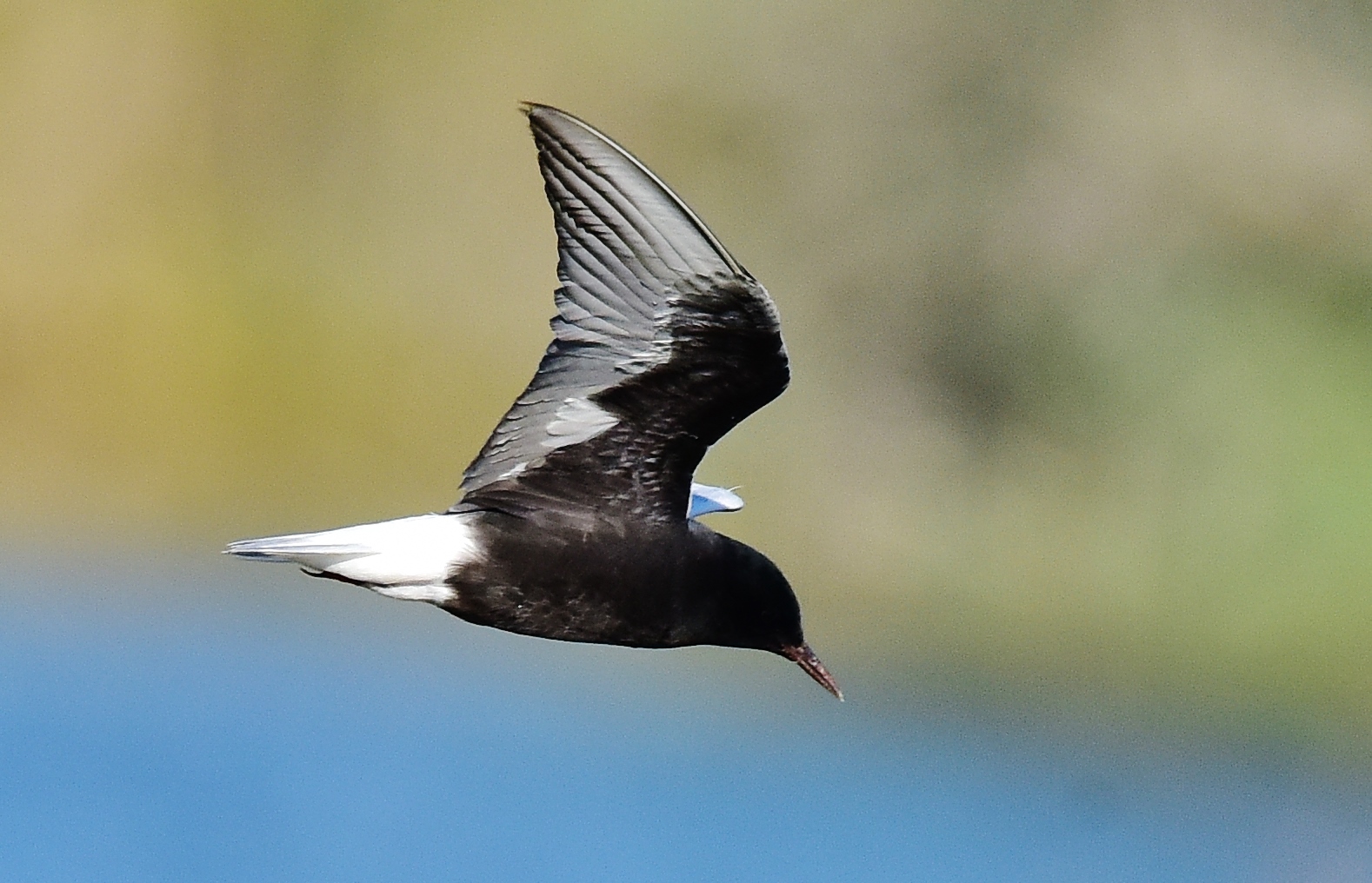
White-winged tern or white-winged black tern - Chlidonias leucopterus (Temminck, 1815) - Αργυρογλάρονο - Ασπρογλάρονο - Cyprus


The white-winged tern, or white-winged black tern (Chlidonias leucopterus or Chlidonias leucoptera), is a small tern generally found in or near bodies of fresh water across from Southeastern Europe east to Australia.
The name 'white-winged tern' is the standard in most English-speaking countries; in Britain, this name is also the one used by the formal ornithological recording authorities, but the older alternative 'white-winged black tern' is still frequent in popular use.
Their breeding habitat is freshwater marshes across from southeast Europe to central Asia. They usually nest either on floating vegetation in a marsh or on the ground very close to water, laying 2-4 eggs in a nest built of small reed stems and other vegetation. In winter, they migrate to Africa, southern Asia and Australia. It is a scarce vagrant in North America, mainly on the Atlantic coast, but a few records on the Pacific coast and inland in the Great Lakes area.
Like the other "marsh" terns (Chlidonias), and unlike the "white" (Sterna) terns, these birds do not dive for fish, but fly slowly over the water to surface-pick items on the surface and catch insects in flight. They mainly eat insects and small fish. In flight, the build appears thick-set. The wing-beats are shallow and leisurely.
The white-winged tern is one of the species to which the Agreement on the Conservation of African-Eurasian Migratory Waterbirds (AEWA) applies..From Wikipedia, the free encyclopedia
Photos Achna by George Konstantinou


Water Pipit (Anthus spinoletta) (Linnaeus,1758) Νεροκελάδα - Cyprus


The water pipit (Anthus spinoletta) is a small passerine bird which breeds in the mountains of southern Europe and southern temperate Asia across to China. It is a short-distance migrant moving to wet open lowlands such as marshes and flooded fields in winter. Some birds migrate north to Britain for winter, taking advantage of the warm oceanic climate
Like most other pipits, this is an undistinguished looking species on the ground, mainly brown above and dark streaked buff below. It has dark legs, white outer tail feathers and a longish dark bill. In summer it has a distinctive breeding plumage, with a pinkish breast, grey head and pale supercilium
The Eurasian rock pipit's subspecies littoralis in summer plumage is very close in outward appearance to the water pipit. They can be told apart by their song, and occupy different habitat types even when they occur in the same general area. The water pipit is also much less approachable than the Eurasian rock pipit, rising high and quickly leaving the vicinity when approached. Water and buff-bellied pipit do not co-occur except in a small area in Central Asia.
This species is insectivorous. Its call is an explosive "fit", like Eurasian rock pipit. Its song is similar, but it consisting of maybe 5 "blocks" of just about half a dozen notes each (the Eurasian rock pipit has fewer, but longer blocks); it ends either with no or with repeated trills.
Formerly included in the water pipit were the subspecies now separated as rock pipit and buff-bellied pipit. The former is more closely related to the water pipit than the latter, as indicated by external and molecular characteristics.From Wikipedia, the free encyclopedia
Photos Achna by George Konstantinou