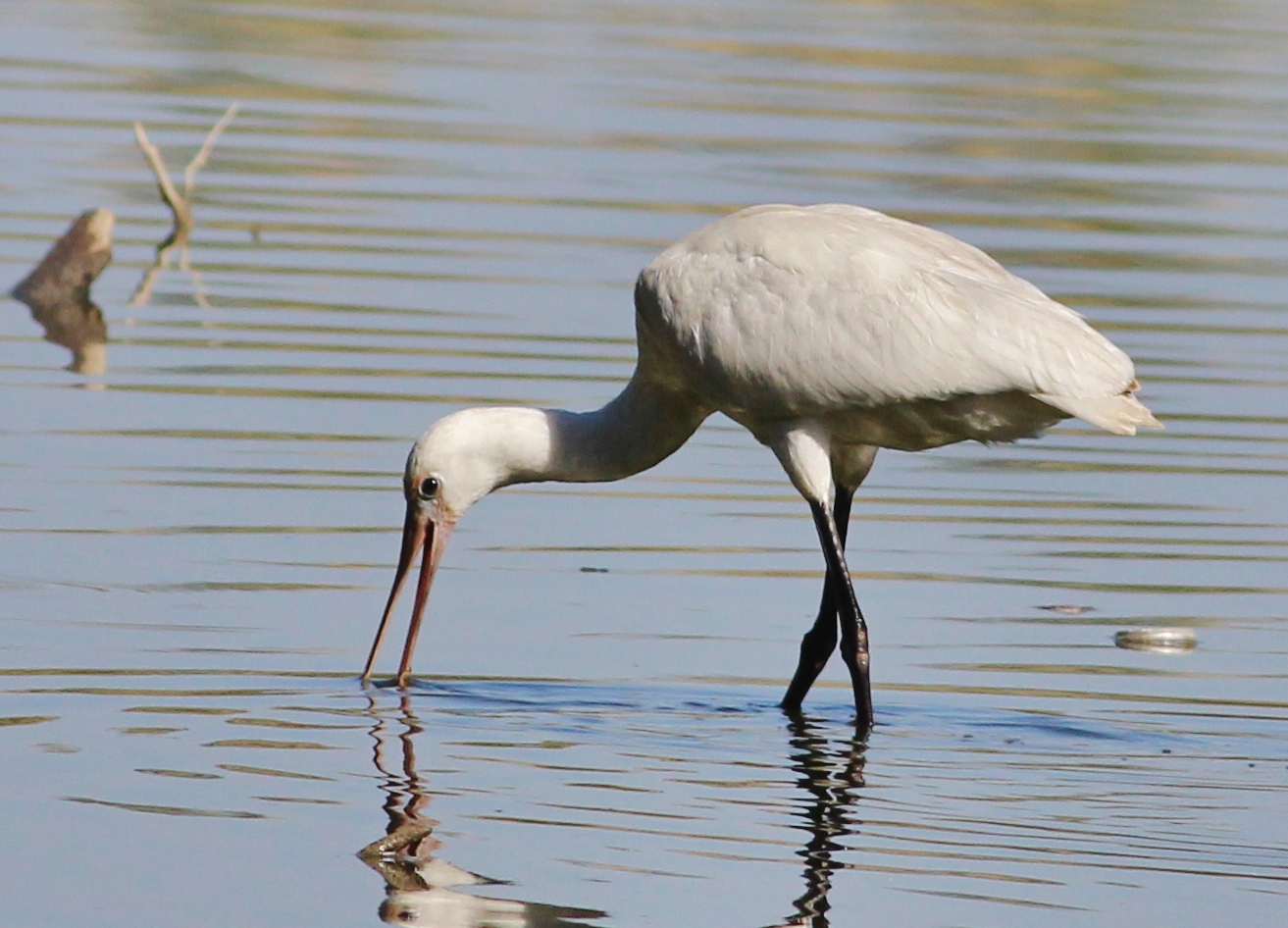
 The Eurasian spoonbill or common spoonbill (Platalea leucorodia) is a wading bird of the ibis and spoonbill family Threskiornithidae,
 This is a Palearctic species, breeding from the United Kingdom and Spain in the west through to Japan, and also in North Africa. In Europe, only The Netherlands, Spain, Austria, Hungary and Greece have sizeable populations. Most birds migrate to the tropics in winter, with European breeders mainly going to Africa, but a few remaining in mild winter areas of western Europe south to the United Kingdom. It was extirpated from the United Kingdom but sporadic breeding attempts in the early 21st century culminated with the formation of a colony at Holkham in Norfolk in 2010. In 2011, 8 breeding pairs nested, successfully fledging 14 young in India.
 This species is almost unmistakable in most of its range. The breeding bird is all white except for its dark legs, black bill with a yellow tip, and a yellow breast patch like a pelican. It has a crest in the breeding season. Non-breeders lack the crest and breast patch, and immature birds have a pale bill and black tips to the primary flight feathers. Unlike herons, spoonbills fly with their necks outstretched. The Eurasian spoonbill differs from the African spoonbill with which in overlaps in winter, in that the latter species has a red face and legs, and no crest.
They are mostly silent. Even at their breeding colonies the main sounds are bill snapping, occasional deep grunting and occasional trumpeting noises.
Eurasian spoonbills show a preference for extensive shallow, wetlands with muddy, clay or fine sandy beds. They may inhabit any type of marsh, river, lake, flooded area and mangrove swamp, whether fresh, brackish or saline, but especially those with islands for nesting or dense emergent vegetation (e.g. reedbeds) and scattered trees or srubs (especially willow Salix spp., oak Quercus spp. or poplar Populusspp.). Eurasian spoonbills may also frequent sheltered marine habitats during the winter such as deltas, estuaries, tidal creeks and coastal lagoons
The diet consists of aquatic insects, mollusks, newts, crustaceans, worms, leeches, frogs, tadpoles and small fish up to 10–15 cm (3.9–5.9 in) long. It may also take algae or small fragments of aquatic plants (although these are possibly ingested accidentally with animal matter)From Wikipedia, the free encyclopedia

 Photos Meneou 8/11/2015 by George Konstantinou




%20%CE%A7%CE%BF%CF%85%CE%BB%CE%B9%CE%B1%CF%81%CE%BF%CE%BC%CF%8D%CF%84%CE%B1%20%E2%80%93%20%CE%9A%CE%BF%CF%85%CF%84%CE%B1%CE%BB%CE%AC%CF%82%20%E2%80%93%20Achna%20dam%205.4.2023%20(30).JPG)
%20%CE%A7%CE%BF%CF%85%CE%BB%CE%B9%CE%B1%CF%81%CE%BF%CE%BC%CF%8D%CF%84%CE%B1%20%E2%80%93%20%CE%9A%CE%BF%CF%85%CF%84%CE%B1%CE%BB%CE%AC%CF%82%20%E2%80%93%20Achna%20dam%205.4.2023%20(34).JPG)
%20%CE%A7%CE%BF%CF%85%CE%BB%CE%B9%CE%B1%CF%81%CE%BF%CE%BC%CF%8D%CF%84%CE%B1%20%E2%80%93%20%CE%9A%CE%BF%CF%85%CF%84%CE%B1%CE%BB%CE%AC%CF%82%20%E2%80%93%20Achna%20dam%205.4.2023%20(84).JPG)
%20%CE%A7%CE%BF%CF%85%CE%BB%CE%B9%CE%B1%CF%81%CE%BF%CE%BC%CF%8D%CF%84%CE%B1%20%E2%80%93%20%CE%9A%CE%BF%CF%85%CF%84%CE%B1%CE%BB%CE%AC%CF%82%20%E2%80%93%20Achna%20dam%205.4.2023%20(89).JPG)
%20%CE%A7%CE%BF%CF%85%CE%BB%CE%B9%CE%B1%CF%81%CE%BF%CE%BC%CF%8D%CF%84%CE%B1%20%E2%80%93%20%CE%9A%CE%BF%CF%85%CF%84%CE%B1%CE%BB%CE%AC%CF%82%20%E2%80%93%20Achna%20dam%205.4.2023..JPG)


%20%CE%9A%CE%BF%CF%85%CF%86%CE%BF%CE%BC%CF%80%CE%B5%CE%BA%CE%AC%CF%84%CF%83%CE%B9%CE%BD%CE%BF%20-%20%CE%9C%CE%BF%CE%BD%CE%BF%CF%80%CE%B9%CE%BA%CE%AC%CF%84%CF%83%CE%BF%CE%BD%CE%BF%20(1).JPG)


