Translate

Saturday, 26 March 2016

Buck's-horn plantain, Minutina or Erba stella - Plantago coronopus subsp. commutata (Guss.) Pilg. - Λιθόσπαστος - Cyprus

Plantago coronopus (known as buck's-horn plantain, minutina or erba stella) is a herbaceous annual to perennial flowering plant in the family Plantaginaceae. It produces a basal rosette of narrowly lance-shaped leaves up to 25 centimeters long that are toothed or deeply divided. The inflorescences grow erect to about 4 to 7 cm in height. They have dense spikes of flowers which sometimes curve.[clarification needed] Each flower has four whitish lobes each measuring about a millimeter long. Plantago coronopus mainly grows on sandy or gravelly soils close to the sea. It is native to Eurasia and North Africa but it can be found elsewhere, including the United States, Australia, and New Zealand as an introduced species.

It is sometimes grown as a leaf vegetable, mostly incorporated in salad mixes for specialty markets.[citation needed] Recently it has become popular as a frost-hardy winter crop for farmers in northern climates, and is usually grown in unheated hightunnels
From Wikipedia, the free encyclopedia
Photos Apostolos Antreas 19/3/2016 by George Konstantinou


Enarthrocarpus arcuatus Labill. - Cyprus

Enarthrocarpus is a genus of flowering plants belonging to the family Brassicaceae.
Its native range is Bulgaria to Arabian Peninsula.
Red Data Book category
Photos Apostolos Antreas 19/3/2016 by George Konstantinou


Cretanweed or Scaly hawkbit - Hedypnois rhagadioloides (L.) F. W. Schmidt - Cyprus


Hedypnois rhagadioloides, the Cretanweed or scaly hawkbit, is a species of plants in the dandelion tribe within the sunflower family. It is native to the Mediterranean Region and neighboring areas from Canary Islands to Iran,[4] and naturalized in Australia and in parts of the Americas (southwestern United States, Baja California in Mexico, central Chile)

Hedypnois rhagadioloides is a thorny annual herb with flower stalks up to 40 centimeter (16 inches) stall, most of the leaves gathered around the base resembling the common dandelion except for the bristles. Leaves are green or purplish, up to 18 centimeters (7.2 inches) long. The plant produces a flower stalk with one single flower head or a flat-topped array of several heads. The head has rows of phyllaries that may be very bristly, and the head is egg-shaped when still closed. Each head contains 8-30 yellow ray flowers but no disc flowers
From Wikipedia, the free encyclopedia

Photos Agios Therissos 19/3/2016 by George Konstantinou


Lotus longisiliquosus R. Roem. - Cyprus

Family Fabaceae

The native range of this species is Medit. It grows primarily in the subtropical biome.

Photos Agios Therissos 19/3/2016 by George Konstantinou


Tordylium aegyptiacum (L.) Poir. - Cyprus


Tordylium is a genus of flowering plants in the carrot family (Apiaceae). Members of the genus are known as hartworts

Tordylium species are annuals or biennials, covered in long hairs. Their stems may be hollow or almost solid. The basal leaves are more-or-less undivided, and have usually disappeared when the plant flowers. The stem leaves are once pinnate. The flowers have persistent sepals and white petals, with those on one side much longer than the other. The fruits are about as long as they are wide. Their side ridges have whitish wings

Species assigned to the genus were first described by Carl Linnaeus in 1753 in Species Plantarum. From Wikipedia, the free encyclopedia

Photos Agios Therissos 19/3/2016 by George Konstantinou


Convolvulus coelesyriacus Boiss. - Cyprus

Convolvulus  is a genus of about 200 to 250 species of flowering plants in the bindweed family Convolvulaceae, with a cosmopolitan distribution. Common names include bindweed and morning glory, both names shared with other closely related genera.

They are annual or perennial herbaceous vines, bines and (a few species of) woody shrubs, growing to 0.3–3 m tall. The leaves are spirally arranged, and the flowers trumpet-shaped, mostly white or pink, but blue, violet, purple or yellow in some species.

Many of the species are problematic weeds, which can swamp other more valuable plants by climbing over them, but some are also cultivated for their attractive flowers. Some species are globally threatened.

Convolvulus species are used as food plants by the larvae of some Lepidoptera species, including the convolvulus hawk moth, the sweet potato leaf miner (Bedellia somnulentella) and the gem; the leaf miner Bucculatrix cantabricella feeds exclusively on C. cantabricus.
From Wikipedia, the free encyclopedia

Photos Larnacas Lapithou 9/4/2006 by George Konstantinou


Friday, 25 March 2016

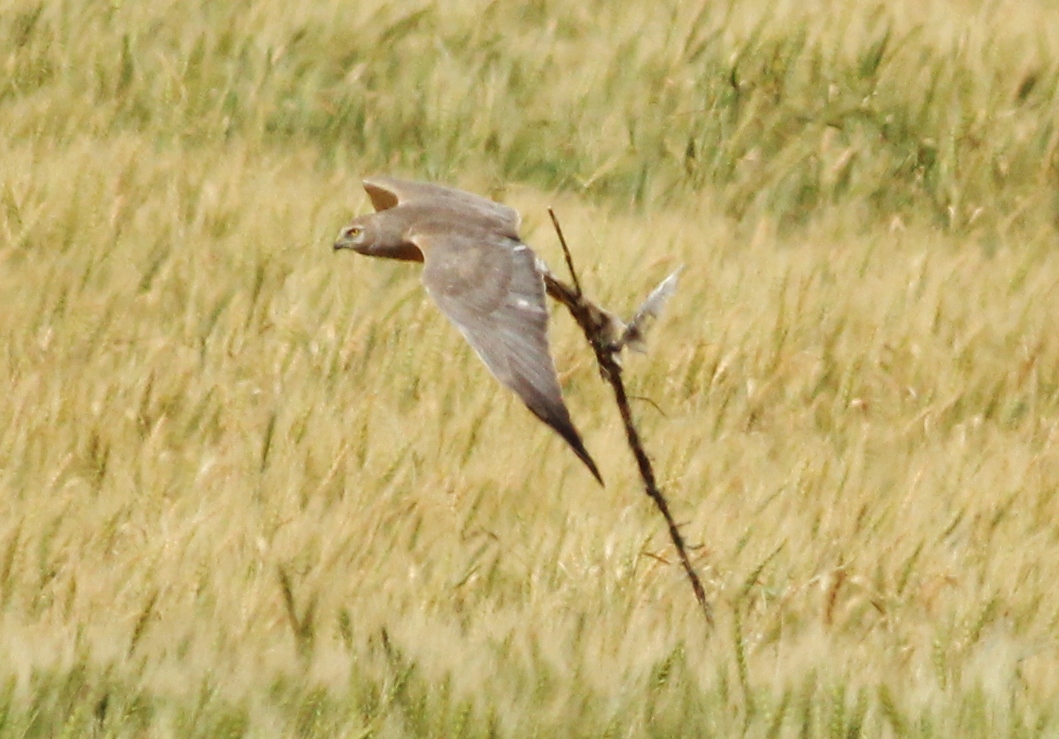
Pallid Harrier has found its leg and tail stuck on limesticks - Cyprus

See also
 - Αρπαχτικά πουλιά της Κύπρου

Pallid Harrier (Circus macrourus) (S. G. Gmelin, 1770) Στεπόκιρκος


"It is not just the song birds that fall victim to the barbaric act of using limesticks! Here a Male Pallid Harrier has found its leg and tail stuck. The fate of this Harrier is not certain as it could end up getting the wings, tail and legs stuck rendering it vulnerable. If he tries to peck the stick off he risks getting his beak stuck together! Either way it is most likely this Harrier will not live a full life due to this! Please stop this madness, we are in the 21st century! Go buy a chicken at the supermarket, stop harming our wildlife!"

Δεν είναι μόνο τα αμπελοπούλια που πέφτουν θύματα της παράνομης παγίδευσης με την χρήση ξοβέργων και δικτύων. 153 είδη της κυπριακής πτηνοπανίδας πέφτουν θύματα της βάναυσης αυτής μεθόδου, τα μισά εκ των οποίων θεωρούνται απειλούμενα.
Βλέπουμε ένα Ασπροσιάχινο (παγκοσμίως κινδυνέυoν είδος) πιασμένο σε ξόβεργο. Η επιβίωση του Αρπροσιάχινου αυτού είναι πλέον αμφίβολη, καθώς η ζημιά που προκάλεσε το ξόβεργο στο φτέρωμα του θα επηρεάσουν την ικανότητα πτήσης του, και άρα την ικανότητα του να κυνηγήσει και να μεταναστεύσει.

Photos  25 of March 2016 at Cape Greco by George Konstantinou


Common Whitethroat, - Sylvia communis Latham, 1787 Θαμνοτσιροβάκος - Cyprus


The common whitethroat (Sylvia communis) is a common and widespread typical warbler which breeds throughout Europe and across much of temperate western Asia. This small passerine bird is strongly migratory, and winters in tropical Africa, Arabia, and Pakistan.

This is one of several Sylvia species that has distinct male and female plumages. Both sexes are mainly brown above and buff below, with chestnut fringes to the secondary remiges. The adult male has a grey head and a white throat. The female lacks the grey head, and the throat is duller. The whitethroat's song is fast and scratchy, with a scolding tone.

The hoarse, a little bit nasal call sounds like wed-wed or woid-woid. The warning cry is long-pulled, rough tschehr which resembles that of the Dartford warbler.

This species may appear to be closely related to the lesser whitethroat, the species having evolved only during the end of the last ice age similar to the willow warbler and chiffchaffs. However, researchers found the presence of a white throat is an unreliable morphological marker for relationships in Sylvia, and the greater and lesser whitethroats are not closely related.[2][3] Chestnut wing patches, like white throats, seem to be plesiomorphic, but indicate phylogeny better. Nonetheless, apart from the whitethroat not being closely related to the lesser whitethroat group, little can be resolved as it seems a fairly basal taxon.
This is a bird of open country and cultivation, with bushes for nesting. The nest is built in low shrub or brambles, and 3–7 eggs are laid. Like most warblers, it is insectivorous, but will also eat berries and other soft fruit.From Wikipedia, the free encyclopedia

Photos and video  25 of March 2016 at Cape Greco by George Konstantinou


Rüppell's warbler - Sylvia rueppelli Temminck, 1823, Crete - Αιγαιοτσιροβάκος - Μουστακοτσιροβάκος - Cyprus


The Rüppell's warbler (Sylvia rueppelli) is a typical warbler of the genus Sylvia. It breeds in Greece, Turkey and neighbouring islands. It is migratory, wintering in north east Africa. This is a rare vagrant to western Europe. The name is occasionally cited as "Rueppell's warbler".

It is a typical "sylvia" warbler, similar in size but slimmer than Sardinian warbler. The adults have a plain grey back and paler grey underparts. The bill is fine and pointed, with brown legs and red eyes. The striking male has a black head and, usually, a black throat, separated by a white malar streak ("moustache"). Females have a pale throat, and the head is grey rather than black. Their grey back has a brownish tinge. The song is a slower, deeper rattle than that of Sardinian warbler.

Together with the Cyprus warbler it forms a superspecies with dark throats, white malar streaks and light remiges fringes. This in turn is related to the species of Mediterranean and Middle East Sylvia warblers that have a naked eye-ring, namely the subalpine warbler, Sardinian warbler and Ménétries's warbler. Both groups have a white malar area, but this may not form a clear streak in the latter group; above the white, the heads of males are uniformly dark.(Helbig 2001, Jønsson & Fjeldså 2006)

These small insectivorous passerine birds are found in thick thorny shrubs where they build their nests and lay four to six eggs.

The species is named after the German zoologist and explorer Eduard Rüppell (1794–1884)
From Wikipedia, the free encyclopedia

Photos and video  25 of March 2016 at Cape Greco by George Konstantinou