Photos 5/5/2016 by George Konstantinou


See also
 Cerianthus membranaceus, the cylinder anemone or coloured tube anemone, is a species of large, tube-dwelling anemone in the family Cerianthidae. It is native to the Mediterranean Sea and adjoining parts of the northeastern Atlantic Ocean.
 Cerianthus membranaceus is a large, tube-dwelling anemone. The oral disc can have a diameter of up to 40 cm (16 in). There are two whorls of tentacles, amounting to about two hundred tentacles in all. Those in the outer whorl are long and slender and armed with cnidocytes (stinging cells) and are used for catching prey. Tentacles in the inner whorl are shorter and function to transfer captured food to the central mouth. The tentacles are sometimes banded and come in an array of colours; white, yellow, orange, green, brown, blue, black, purple and violet. The colour of the inner whorl often contrasts with that of the outer whorl.
 The column of this tube anemone secretes mucus in which is embedded a unique type of cnidocytes that mesh together to form a fibrous structure. Sand and other particles adhere to this and it forms a leathery, protective tube up to 40 cm (16 in) in length. There is no pedal attachment and the lower end of the tube is buried in the soft substrate. The tube is open at the base which allows for escape of water when the animal retreats into the tube
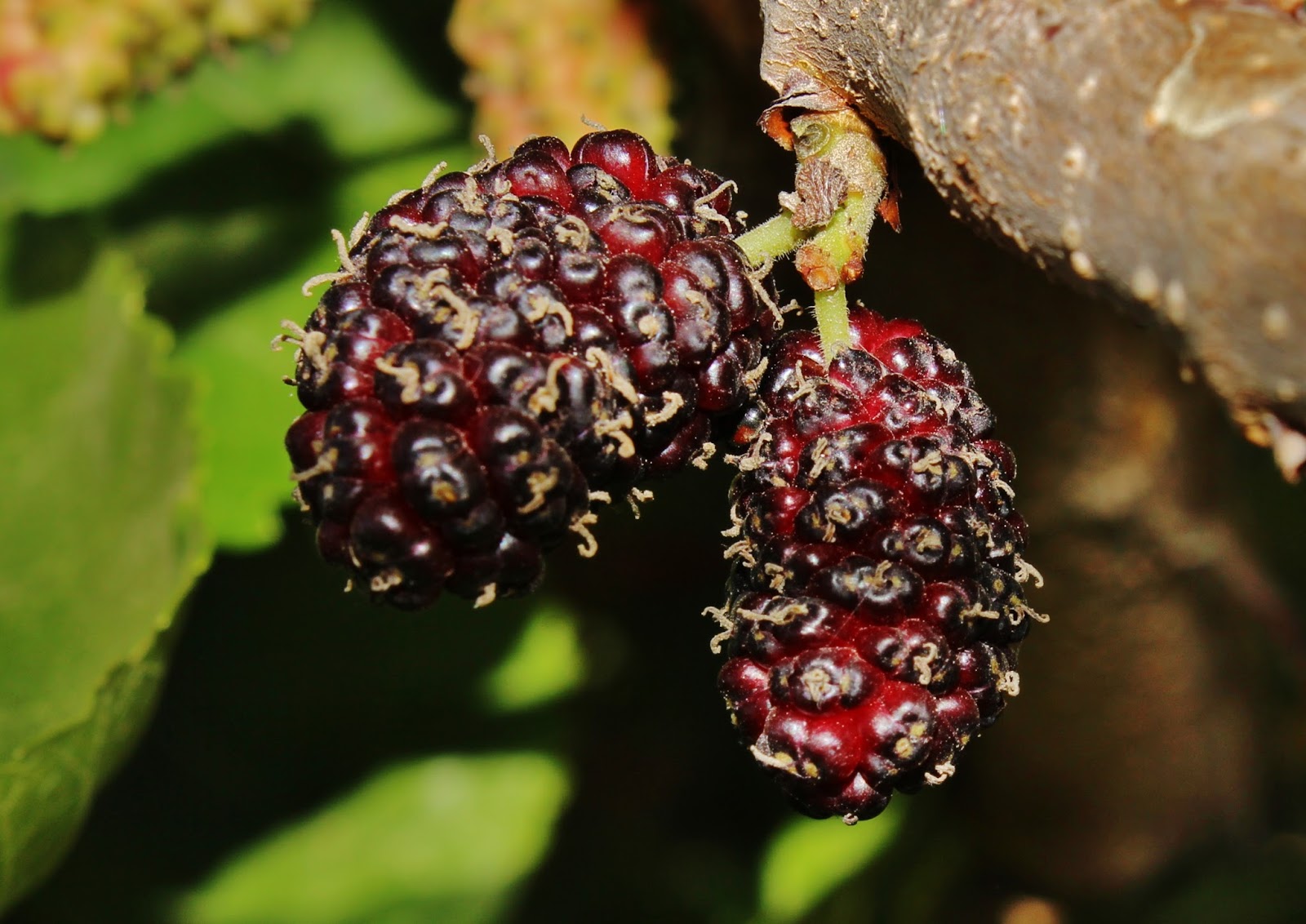
 Morus rubra, commonly known as the red mulberry, is a species of mulberry native to eastern and central North America. It is found from Ontario, Minnesota, and Vermont south to southern Florida, and west as far as southeastern South Dakota, Nebraska, Kansas, and central Texas. There have been reports of isolated populations (very likely naturalized) in New Mexico, Idaho, and British Columbia.
 Common in the United States, it is listed as an endangered species in Canada, and is susceptible to hybridization with the invasive white mulberry (M. alba), introduced from Asia.
 Red mulberry is a deciduous tree, growing to 10–15 m tall, rarely 20 m, with a trunk up to 50 cm diameter. The leaves are alternate, 7–14 cm long and 6–12 cm broad, simple, broadly cordate, with a shallow notch at the base, typically unlobed on mature trees although often with 2-3 lobes, particularly on young trees, and with a finely serrated margin. The upper surface of the leaves is noticeably rough, similar in texture to fine sandpaper, and unlike the lustrous upper surface of the leaves of white mulberry (M. alba). The underside of the leaves is covered with soft hairs. The leaf petiole exudes milky sap when severed. Red mulberry is hardy to subzero temperatures, relatively hardy to drought, pollution, and poor soil, though the white mulberry is hardier.



 Oenothera is a genus of about 145 species of herbaceous flowering plants native to the Americas. It is the type genus of the family Onagraceae. Common names include evening primrose, suncups, and sundrops. They are not closely related to the true primroses (genus Primula).

 The species vary in size from small alpine plants 10 centimeters tall, such as O. acaulis from Chile, to vigorous lowland species growing to 3 meters, such as O. stubbei from Mexico. The leaves form a basal rosette at ground level and spiral up to the flowering stems. The blades are dentate or deeply lobed (pinnatifid). The flowers of many species open in the evening, hence the name "evening primrose". They may open in under a minute. Most species have yellow flowers, but some have white, purple, pink, or red. Most native desert species are white. Oenothera caespitosa, a species of western North America, produces white flowers that turn pink with age. One of the most distinctive features of the flower is the stigma, which has four branches in an X shape.
 Oenothera flowers are pollinated by insects, such as moths and bees. Like many other members of the Onagraceae, however, the pollen grains are loosely held together by viscin threads, so only insects that are morphologically specialized to gather this pollen can effectively pollinate the flowers. Bees with typical scopa cannot hold it. Also, the flowers open at a time when most bee species are inactive, so the bees which visit Oenothera are generally vespertine temporal specialists: bees that forage in the evening. The seeds ripen from late summer to fall.
 In the wild, evening primroses act as primary colonizers, quickly appearing in recently cleared areas. They germinate in disturbed soils, and can be found in habitat types such as dunes, roadsides, railway embankments, and waste areas. They are often casual and are eventually outcompeted by other species.

