Translate

Sunday, 27 September 2015

Dermestes frischii (Kugelann, 1792) - Cyprus

Dermestes is a genus of larder beetles in the family Dermestidae. Both the adult beetles and the larvae feed on dry dead animals and vegetable material. Dermestes, especially its larvae, can seriously damage natural animal fibers, foodstuff, furnishing and zoological collections. Larder beetles are common throughout the world and are a serious pest in some places.From Wikipedia, the free encyclopedia

.Photos Geri 26/9/2015 by George Konstantinou


Phorcus turbinatus or Monodonta turbinata (Born, 1780) - Χολιός - Cyprus

FamilyTrochidae

Phorcus turbinatus, common name the turbinate monodont, is a species of sea snail, a marine gastropod mollusk in the familyTrochidae, the top snails
The size of the shell varies between 15 mm and 43 mm. The very solid and thick, imperforate shell has a conical shape. It is whitish, tinged with gray, yellowish or greenish, tessellated with numerous spiral series of reddish, purple or chocolate subquadrangular blotches. The conoid spire is more or less elevated. The apex is eroded. The about 6 whorls are slightly convex, with impressed spiral lines between the series of blotches, the last generally descending anteriorly. The base of the shell is eroded in front of the aperture. The aperture is very oblique. The thick, smooth outer lip is beveled to an edge. It is pearly and iridescent within. The columella is flattened on the face, bluntly lobed within, pearly, backed by an opaque white layer.
This marine species occurs in the following locations:


  • Mediterranean Sea
  • Greek Exclusive Economic Zone
  • Portuguese Exclusive Economic Zone
  • Spanish Exclusive Economic Zone (Spain, Canary Islands)
  • .From Wikipedia, the free encyclopedia

    .Photos Potamos tou Kmpou 15/7/2015 by George Konstantinou

Ants - Messor sp. - Cyprus


Messor is a myrmicine genus of ants with more than 100 species, all of which are harvester ants; the generic name comes from the Roman god of crops and harvest, Messor. The subterranean colonies tend to be found in open fields and near roadsides, openings are directly to the surface. The Vessomessor genus was recently added to messor adding 8 more species.
Colonies can achieve huge sizes and are notable for their intricately designed granaries in which seeds are stored in dry conditions, preventing germination. The structure of Messor spp. nests is complex and the genus on the whole is one of very accomplished architects.


Messor spp. are polymorphic and have a distinct caste of macrocephalic dinoergates whose role is of carrying and cutting the large seeds which comprise much of the colonies' subsistence. Althouth they primarily feed on seeds, they occasionally eat insects and snails. Some snail shells possibly are taken into the nest because of their grain-like shape.
Equipped with a tough shining cuticle, Messor spp. are slow moving and form long, seed-carrying runs. Colonies tend to be monogynous and are founded by a single queen alone..From Wikipedia, the free encyclopedia


Messor  queen 9/11/2017 by George Konstantinou
Photos Geri 27/9/2015 by George Konstantinou


Male
Female & Male (back)


Photos at Lakatamia, 17/12/2015 by Michael Hadjiconstantis

Heliophanillus fulgens (O. P.-Cambridge, 1872) - Jumping spider - Cyprus

Family: Salticidae

Heliophanillus fulgens is a jumping spider species in the genus Heliophanillus that can be found in a large distribution that extends from Greece to Central Asia. The species, which was first described in 1872, was originally named Salticus fulgens, but was later placed successively in the genera Euophrys and Icius before the current name was agreed in 1989. The spider is small, ranging in body length between 2.25 and 3.3 millimetres (0.09 and 0.13 in), the female being larger than the male. It is rusty brown with white hairs and primarily lives around the Eastern Mediterranean from Greece into North Africa and Asia.

Taxonomy
The species was first described in 1872 by Octavius Pickard-Cambridge and named Salticus fulgens, in the genus Salticus. In 1876, Eugène Simon named a spider in the Euophrys as Euophrys fulgens, but then subsequently described the same spider in 1890, in its female form, and 1901, in its male form, but named Heliophanus lucipeta. In 1986, Wanda Wesołowska transferred Heliophanus lucipeta to the species Pseudicius. In 1988, Wesołowska transferred both species to the genus Icius as Icius fulgens and Icius lucipeta respectively.[4] The following year, Jerzy Prószyński transferred them to the genus Heliophanillus and described another spider species, although the male only, called Heliophanillus arabicus. In 1994, this new species was recognised as a synonym of Heliophanus fulgens and, finally, in 2007, Heliophanillus lucipeta was also named as a synonym of the species.

Description
Heliophanillus fulgens is a small jumping spider. It is rusty brown with white hairs and clear orange-brown iridescent scales. The male is between 2.25 and 2.9 millimetres (0.09 and 0.11 in) in body length, while the female is larger, typically with a body 3.3 millimetres (0.13 in) long. From Wikipedia, the free encyclopedia

Photos at Meneou, 11/8/2015,  by George Konstantinou


.


Saturday, 26 September 2015

Scaurus nielseni - Cyprus


Photos Geri by George Konstantinou


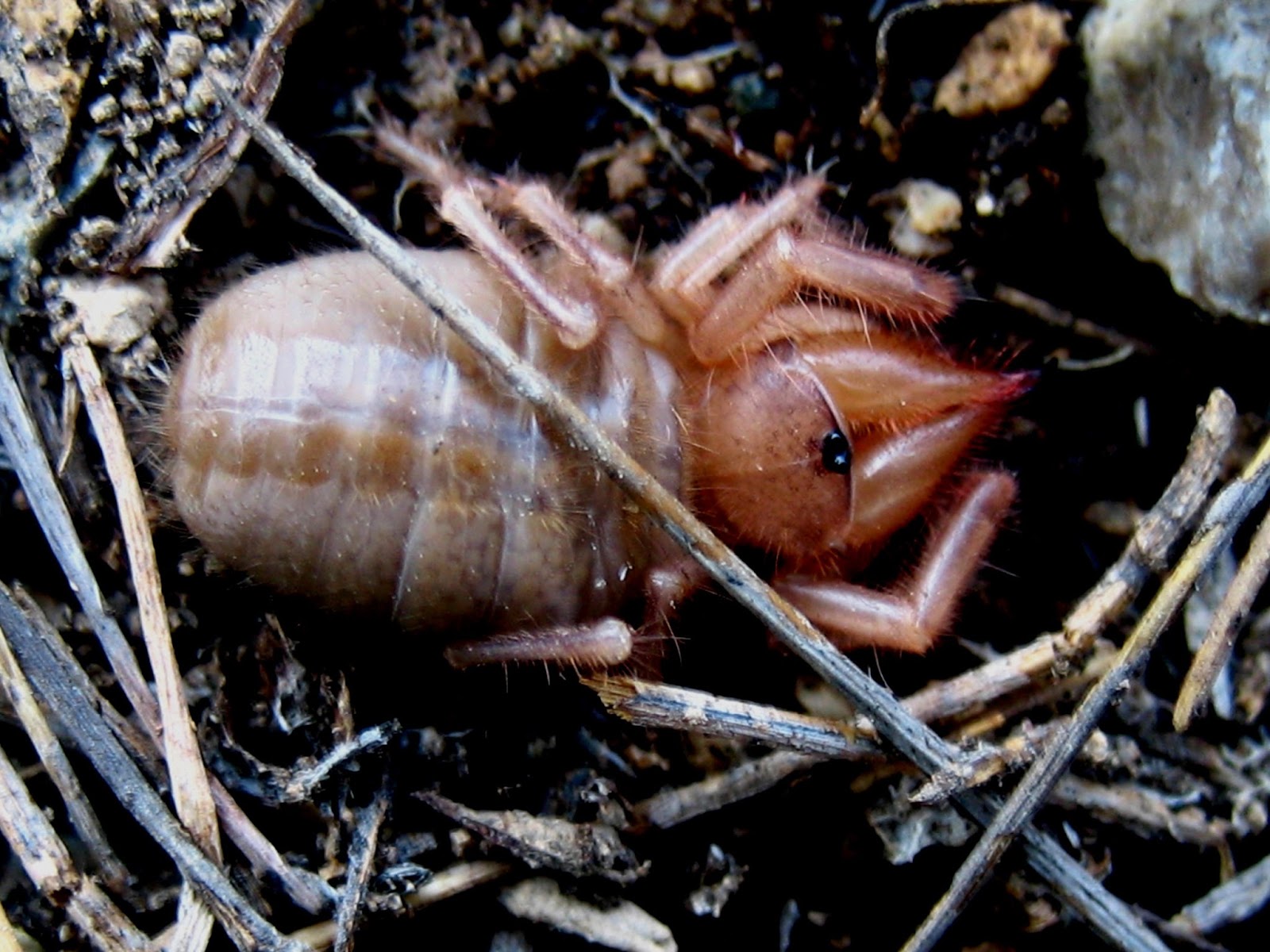
Camel spider - Cyprus


The Solifugae are an order of animals in the class Arachnida known variously as camel spiderswind scorpionssun spiders, or solifuges. The order includes more than 1,000 described species in about 153 genera. Much like a spider, the body of a solifugid has two tagmata: an opisthosoma (abdomen) behind the prosoma (that is, in effect, a combined head and thorax). At the front end, the prosoma bears two chelicerae that, in most species, are conspicuously large. The chelicerae serve as jaws and in many species also are used forstridulation. Unlike scorpions, solifugids do not have a third tagma that forms a "tail". Most species of Solifugae live in dry climates and feed opportunistically on ground-dwelling arthropods and other small animals. The largest species grow to a length of 12–15 cm (5–6 in), including legs. A number of urban legends exaggerate the size and speed of the Solifugae, and their potential danger to humans, which is negligible.From Wikipedia, the free encyclopedia

.Photos Agios Sozomenos 19/1/2006  by George Konstantinou


Friday, 25 September 2015

Cypriot mouse - Mus cypriacus (Cucchi et al., 2006) - Κυπριακός Ποντίκός - Endemic to Cyprus

See also

Λίστα των θηλαστικών της Κύπρου - List of mammals of Cyprus


First New Mammal Found in Europe in 100 Years (2006)

Endemic to Cyprus
The Cypriot mouse (Mus cypriacus) is a species of mouse native to Cyprus. Its primary habitat seems to be the vineyards and fields 
The mouse was recognized as a new species in 2004 by Thomas Cucchi, a research fellow at the University of Durham. It was formally described in 2006, in Zootaxa.

The Cypriot mouse has characteristics that distinguish it from European mice: bigger ears, eyes and teeth; DNA tests confirmed that it was a distinct species.
"All other endemic mammals of Mediterranean islands died out following the arrival of man, with the exception of two species of shrew. The new mouse of Cyprus is the only endemic rodent still alive, and as such can be considered as a living fossil," said Dr. Cucchi. Originally, Dr. Cucchi wanted to call it Mus aphrodite, as Cyprus is the birthplace of Aphrodite according to Greek mythology.
From Wikipedia, the free encyclopedia

Ο κυπριακός ποντικός εμφανίζει εξωτερικά τα τυπικά χαρακτηριστικά του γένους του. Το τρίχωμά του εμφανίζει ένα ομοιόμορφο γκρίζο - καφετί χρωματισμό στο ραχιαίο μέρος του σώματός του, ενώ κοιλιακά το χρώμα είναι
ελαφρά πιο ανοικτό έως λευκό. Το ρύγχος του είναι οξύληκτο και τα πτερύγια των αυτιών του είναι πολύ μεγάλα σε σχέση με τα υπόλοιπα είδη του γένους Μus.

Σύμφωνα με τους Cucchi et al., 2006, στην οπίσθια επιφάνειά τους τα πτερύγια των αυτιών φέρουν λευκό τρίχωμα. Τα μάτια του είναι επίσης πολύ μεγαλύτερα και προεξέχοντα. Η ουρά του είναι μεγάλη σε μήκος σε σχέση με τον κεφαλοκορμό του
(αν και συνήθως λίγο μικρότερη από την ουρά του M. musculus domesticus) και
χαρακτηρίζεται από μεταμερικούς δακτυλίους (Cucchi et al., 2006).
Το μήκος του σώματος (των ενηλίκων ατόμων εξαιρουμένης της ουράς) είναι 75
- 91 mm. Η ουρά έχει μήκος 63 - 87 mm, ενώ το μήκος του οπίσθιου ακροποδίου
είναι 16 - 19 mm. Ο οδοντικός τύπος του είδους είναι 1/1, 0/0, 0/0, 3/3 = 16, με τους
κοπτήρες της άνω γνάθου να έχουν μια διακριτή εγκοπή στην οπίσθια επιφάνεια του
ελεύθερου άκρου του, η οποία είναι ορατή σε πλάγια όψη (Cucchi et al., 2006). 
Το είδος αυτό ανακαλύφθηκε σχετικά πρόσφατα (Cucchi et al., 2006) και
θεωρείται ότι είναι αγροδίαιτο είδος, το οποίο εξαπλώνεται στην περιοχή του Όρους
Τρόοδος σε υψόμετρο 300 - 900 m. Ο βιότοπός του περιλαμβάνει εγκαταλειμμένους
αμπελώνες, λιβάδια και θαμνώδεις εκτάσεις. Σε υψόμετρο 100 - 150 m θεωρείται
από τους ίδιους μελετητές ότι ζει συντοπικά με τον σπιτικό ποντικό σε παραποτάμια
δάση. Κατά τους ίδιους ερευνητές δεν εξαπλώνεται σε περιοχές με υψόμετρο
χαμηλότερο των 100m, καθώς και σε περιοχές με ισχυρή ανθρωπογενή πίεση, όπως
καλλιέργειες στη Μεσαορία (στο κεντρικό τμήμα του νησιού), ανθρώπινες κατοικίες
και φάρμες, όπου εξαπλώνεται κυρίως το Mus musculus domesticus.
Συμπεριφορά
Όπως και ο σπιτικός ποντικός, είναι νυκτόβιος οργανισμός αφού οι
περισσότερες μετακινήσεις του, η πρόσληψη τροφής και νερού γίνονται κυρίως κατά
τις νυκτερινές ώρες, ενώ αναπαύεται την ημέρα.
Τροφή
Είναι παμφάγο ζώο, η διατροφή του περιλαμβάνει σχεδόν τα πάντα, όμως
εμφανίζει προτίμηση προς τους καρπούς των δημητριακών.
Αναπαραγωγή
Μέχρι στιγμής δεν υπάρχουν στοιχεία που να αφορούν στην αναπαραγωγική
δραστηριότητα του είδους. 
Photos Geri 23/4/2010 by George Konstantinou


Thursday, 24 September 2015

Εκπομπή στον ASTRA 92,8 και 105,3 ' " Αλεπού " Με τον Γιώργο Κωνσταντίνου

24/9/2015

 Εκπομπή στον ASTRA 92,8 και 105,3 την επομένη Πέμπτη , λίγο μετά τις 9:00 με την Σόνια Φιλίππου !!!
Το θέμα μας θα είναι :
 " Αλεπού " που θα μας το αναπτύξει ο φιλοξενούμενος μας Κος Γιώργος Κωνσταντίνου ειδικός Φυσιοδίφης , ερευνητής βιοποικιλότητας και φωτογράφος και κινηματογραφιστής ‘άγριας ζωής και πρόεδρος του συνδέσμου προστασίας φυσικής κληρονομιάς και βιοποικιλότητας της Κύπρου.


Monday, 21 September 2015

House mouse - Mus musculus domesticus Linnaeus, 1758 - Οικιακός ποντικός - Cyprus

See also
The house mouse (Mus musculus) is a small mammal of the order Rodentia, characteristically having a pointed snout, small rounded ears, and a long naked or almost hairless tail. It is one of the most numerous species of the genus Mus. Although a wild animal, the house mouse mainly lives in association with humans.
The house mouse has been domesticated as the pet or fancy mouse, and as the laboratory mouse, which is one of the most important model organisms in biology and medicine. The complete mouse reference genome was sequenced in 2002. It is by far the most commonly genetically altered mammal in scientific research
House mice have an adult body length (nose to base of tail) of 7.5–10 cm (3.0–3.9 in) and a tail length of 5–10 cm (2.0–3.9 in). The weight is typically 10–25 g (0.4–0.9 oz). In the wild they vary in color from light to dark agouti (light to dark brown), but domesticated fancy mice and laboratory mice are produced in many colors ranging from white to champagne to black. They have short hair and some, but not all, sub-species have a light belly. The ears and tail have little hair. The hind feet are short compared to Apodemus mice, only 15–19 mm (0.59–0.75 in) long; the normal gait is a run with a stride of about 4.5 cm (1.8 in), though they can jump vertically up to 45 cm (18 in).The voice is a high-pitched squeak. House mice thrive under a variety of conditions; they are found in and around homes and commercial structures, as well as in open fields and agricultural lands.
Newborn males and females can be distinguished on close examination as the anogenital distance in males is about double that of the female. From the age of about 10 days, females have five pairs of mammary glands and nipples; males have no nipples. When sexually mature, the most striking and obvious difference is the presence of testicles on the males. These are large compared to the rest of the body and can be retracted into the body.
The tail, which is used for balance, has only a thin covering of hair as it is the main peripheral organ of heat loss in thermoregulation along with — to a lesser extent — the hairless parts of the paws and ears. Blood flow to the tail can be precisely controlled in response to changes in ambient temperature using a system of arteriovenous anastomoses to increase the temperature of the skin on the tail by as much as 10 °C to lose body heat. Tail length varies according to the environmental temperature of the mouse during postnatal development, so mice living in colder regions tend to have shorter tails. The tail is also used for balance when the mouse is climbing or running, or as a base when the animal stands on its hind legs (a behaviour known as tripoding), and to convey information about the dominance status of an individual in encounters with other mice.From Wikipedia, the free encyclopedia
Photos and video Geri 21/9/2015 by George Konstantinou

Photos by Michael Hadjiconstantis
                                                        Mus musculus (House mouse) nest with a 12 babies


Giant tun - Tonna galea (Linnaeus, 1758) - Cyprus

Family Tonnidae

Tonna galea, commonly known as the giant tun, is a species of marine gastropod mollusc in the family Tonnidae (also known as the tun shells). This very large sea snail or tun snail is found in the North Atlantic Ocean as far as the coast of West Africa, in the Mediterranean Sea and the Caribbean Sea. The species was first described by Carl Linnaeus in 1758
The shell of adult Tonna galea is very large, with an average height of 6 inches (150 mm). In terms of its weight however, the shell is very much lighter than the shell of most other large sea snails. The aperture of the shell is "distinctly round" and wide,[4] Shells of this species are often yellow-white in colour, with a blotch or band pattern that is brown.[3] The shell is thin and inflated, but still relatively solid and durable.
Tonna galea possess large salivary glands. The structure of these glands was first described and detailed by Heinrich Weber in 1927.Furthermore, the Giant Tun is also a luminescent species; this is an extremely rare characteristic among the prosobranch gastropods. The animal gives off light that is green-white in colour when it traverses through the water with its foot "well-extended"
This large sea snail is found in the North Atlantic Ocean (specifically the Canary Islands and Madeira), the Mediterranean Sea, the  Caribbean Sea, and in the waters off the coast of Angola, Cape Verde and West Africa. The preferred habitat for this species isseabeds that are muddy or sandy with seagrass beds. In the Mediterranean, these snails are typically found at depths ranging from just beneath the surface to 120 metres (390 ft).
Tonna galea has been placed on Annex II of both the Berne Convention on the Conservation of European Wildlife and Natural HabitatsNand the Protocol of the Barcelona Convention for Protection against Pollution in the Mediterranean Sea. In spite these designations, it continues to be "exploited"
Information on the biology and life history of Tonna galea is scarce, due to the fact that the species has only rarely been studied. It is carnivorous, and utilizes its two proboscises—located on top of its head—to envelop its prey, which primarily consists of sea cucumbers. To a lesser extent it also feeds on sea urchinsstarfish. fish, bivalves and crustaceans. As a defense mechanism, the snail will squirt its highly-acidic saliva when disturbed. This contains approximately 2–5% sulfuric acid, which is used to kill its prey. The presence of this acid was recorded by Franz Hermann Troschel in 1854

From Wikipedia, the free encyclopedia
Photos by George Konstantinou
Underwater photos by Kostas Aristeidou
Photos and video by Costas Constantinou