Translate

Thursday, 8 October 2015

Evania appendigaster (Linnaeus, 1758) - Cyprus


Evania appendigaster is a species of wasp in the family Evaniidae, the ensign wasps. Its native range is not known, but it likely originated in Asia. Today it occurs throughout the tropics and subtropics and in many temperate regions. It is a parasitoid wasp known for specializing on cockroaches.
This is one of the larger ensign wasps, with forewings up to about 7 millimeters long. It is distinguished from other species by the wide separation of the first and second sections of the coxa, the segment of the leg that attaches to the body. It is black in color. The abdominal petiole, the constricted stalk that holds the posterior section of the abdomen, or gaster, is attached high on the body. The gaster is laterally compressed and oval to nearly triangular in shape, held in a flaglike fashion and resembling an ensign, a characteristic of the family that inspired the common name ensign wasp
This wasp reproduces by laying eggs in the egg cases, or oothecae, of cockroaches. The wasplarvae use the cockroach eggs as a food source. Host cockroaches include the American cockroach (Periplaneta americana), Australian cockroach (P. australasiae), brown cockroach (P. brunnea), Oriental cockroach (Blatta orientalis), whitemargined cockroach (Melanozosteria soror), and harlequin cockroach (Neostylopyga rhombifolia).
Detailed descriptions of the oviposition process in this species have been published. As one 1920 account describes it, "the Evaniid left the inside wall of the confining tumbler, ran over the Blattid ootheca, crawled over the surface momentarily as she actively vibrated her antenna and finally settled upon it with the long axis of her body parallel with the long axis of the egg mass as it lay upon its right side. Having satisfactorily settled herself, lying upon her right side she extended her ovipositor and crawling slightly forward she punctured the ootheca in the fifth egg cell of the left side, remaining in position for about fifteen minutes. She then left the egg mass and resting upon the inside wall of the tumbler actively cleaned the ovipositor, wings and antennae.
As a 1957 account describes the "peculiar" egg-laying behavior, "the female lies on her side and, with legs braced against the oötheca, penetrates the tough integument of the egg-capsule after about half-an-hour's hard labour. The process apparently requires "a good deal of hard work and much wriggling of the abdomen.
Other authors describe it as a seven-step process. The wasp lands on the ootheca and drums on it with her antennae. During step two, she extends her ovipositor and taps on the ootheca in several places for up to ten minutes, apparently searching for an appropriate site. After a rest period she begins "drilling", repeatedly inserting her ovipositor. Step five is the actual oviposition stage, in which wasps "just sit on ootheca and lay eggs" Steps six and seven are the withdrawal of the ovipositor and departure, respectively.
One egg is deposited in each cockroach egg capsule, and the wasp larva consumes all the eggs within it. The larva proceeds through five instars during development, stages which are distinguished by the changes in the unique mandibles. The first instar has mandibles with small, sharp teeth which it must use to open the tough cockroach eggs.During the next two instars, the larva has longer mandibles which are "shaped like a gauntlet glove with three teeth. The final two instars have thicker mandibles with a long, blunt upper tooth and a narrow, curving lower tooth.
When the larva reaches about 8 millimeters in length it pupates. Upon maturity it cuts a hole in the egg capsule and exits. The adult wasp lives for two or three weeks. It may spend some time on plants such as parsley and fennel. From Wikipedia, the free encyclopedia

.Photos Geri 8/10/2015  by George Konstantinou


blady grass, cogon grass, kunai grass , or Japanese bloodgrass - Imperata cylindrica (L.) P.Beauv. - Καζάβιν - Cyprus

Imperata cylindrica, commonly known as blady grasscogon grasskunai grass , or Japanese bloodgrass, is a species of grass in the genus Imperata. It is placed in the subfamily Panicoideae, supertribe Andropogonodae, tribe Andropogoneae.
It is a perennial rhizomatous grass native to east and southeast Asia, India, Micronesia, Melanesia, Australia, and eastern and southern Africa. It grows from 0.6–3 m (2–10 feet) tall. The leaves are about 2 cm wide near the base of the plant and narrow to a sharp point at the top; the margins are finely toothed and are embedded with sharp silica crystals. The main vein is a lighter colour than the rest of the leaf and tends to be nearer to one side of the leaf. The upper surface is hairy near the base of the plant while the underside is usually hairless. Roots are up to 1.2 meters deep, but 0.4 m is typical in sandy soil.
It is used for thatching the roofs of traditional homes throughout south-east Asia.
It is planted extensively for ground cover and soil stabilization near beach areas and other areas subject to erosion. Other uses include paper-making, thatching and weaving into mats and bags. It is used in traditional Chinese medicine.
A number of cultivars have been selected for garden use as ornamental plants, including the red-leaved 'Red Baron', also known as Japanese blood grass.
Young inflorescences and shoots may be eaten cooked, and the roots contain starch and sugars and are therefore easy to chew. From Wikipedia, the free encyclopedia

.Photos Geri 29/6/2015  by George Konstantinou


Τα βουνά της Τουρκίας απο τον κατεχώμενο Άγιο Επίκτητο - 7/10/2013 - The mountains of Turkey from Agios Epiktitos- Cyprus

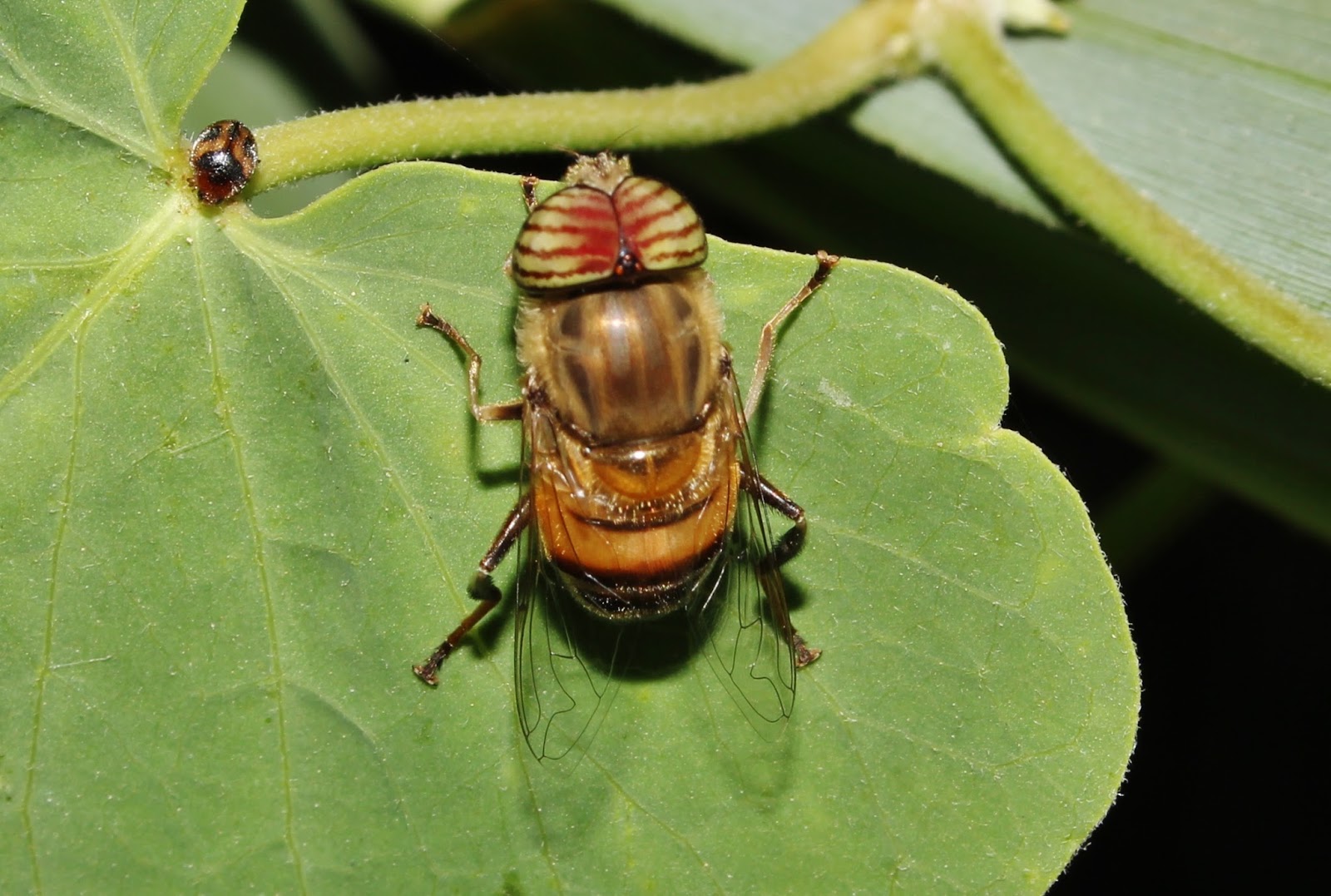
Band-eyed drone fly - Eristalinus taeniops (Wiedemann, 1818) - Cyprus

Family: Syrphidae

Eristalinus taeniops is a species of hoverfly, also known as the band-eyed drone fly.
Portugal, Spain and around the Mediterranean, Turkey, Lebanon, Israel, North Africa, The Canary Islands, The Caucasus, Eastern parts of Afrotropical region to South Africa, Nepal Northern Pakistan and Northern India, Iran. Introduced to Parts of North America (California and Florida).
Eristalinus is a genus of hoverfly. Most species have very distinctive eye marking in the form of spots or banding, though these features may fade on some preserved specimens. Most are stout flies, and are nimble flyers, even compared to other hoverfly species.
At one time the members of this genus were divided into three clades (EristalinusEristalodes and Lathyrophthalmus) based onmorphological characters such as whether the eyes were spotted or striped. Recently Pérez-Bañon et al. studying the European species of Eristalinus using a combination of molecular data and male genitalia characters have determined that the genus in Europe at least, divides neatly into two clades - Eristalinus (+ Lathyrophthalmus) & Eristalodes. It was also discovered that the eye patterning was not taxonomically important as Eristalodes contained members with eyes either spotted or striped
From Wikipedia, the free encyclopedia

.Photos Geri 5/7/2015  by George Konstantinou


Wednesday, 7 October 2015

Mediterranean fruit fly, or medfly - Ceratitis capitata (Wiedemann, 1824) - Μεσογειακή μύγα - Cyprus


Ceratitis capitata, the Mediterranean fruit fly, or medfly for short, is a species of fruit fly capable of causing extensive damage to a wide range of fruit crops. It is native to the Mediterranean area, but has spread invasively to many parts of the world, including Australasia and North and South America.
Adult medflies lay their eggs under the skins of fruit, particularly where the skin is already broken. The eggs hatch within three days, and the larvae develop inside the fruit. The adults have a limited ability to disperse, but the global fruit trade can transport infected fruit over thousands of miles.
This updated map provides information on the distribution of the Mediterranean fruit fly, Ceratitis capitata, throughout the world. The information is mainly based on available Mediterranean fruit fly national surveillance reports. Therefore, the map displays assessments of the presence of this pest at the national level and in some cases at sub-national levels.
In the United StatesC. capitata has invaded four states (HawaiiCaliforniaTexas and Florida), but has been eradicated from all but Hawaii. Reintroduced populations of the medfly have been spotted in California as recently as mid September 2009, requiring additional eradication and quarantine efforts. It has also been eradicated from New Zealand and Chile.From Wikipedia, the free encyclopedia

.Photos Geri 26/5/2011  by George Konstantinou


Η ΜΕΣΟΓΕΙΑΚΗ ΜΥΓΑ ΚΑΙ Η ΚΑΤΑΠΟΛΕΜΗΣΗ ΤΗΣ - 07/09/2005

Κλάδος Προστασίας Φυτών στο Τμήμα Γεωργίας
Η Μεσογειακή μύγα είναι ένας από τους πιο σοβαρούς εχθρούς των φρούτων στο νησί μας. Τα σκουλήκια της κατατρώγουν τους καρπούς και προκαλούν το λιώσιμο τους. Η γνώση των μορφολογικών χαρακτηριστικών και του βιολογικού κύκλου του εντόμου, από τους φρουτοπαραγωγούς, αποτελεί απαραίτητη προϋπόθεση για μια αποτελεσματική καταπολέμησή του.

Στο άρθρο αυτό δίνονται οι αναγκαίες πληροφορίες για την αντιμετώπιση του σοβαρού αυτού εχθρού των φρούτων.
Tι είναι η Μεσογειακή μύγα

Η Μεσογειακή μύγα (Ceratitis capitata-Wield) ανήκει στην τάξη των Διπτέρων, δηλαδή στην ομάδα των μυγών. Το τέλειο έντομο έχει μήκος 5 χιλ. και είναι λίγο μικρότερο της οικιακής μύγας. Κύριο χαρακτηριστικό του είναι ότι τα φτερά του είναι σχεδόν διαφανή με πολλές καστανές και μαύρες κηλίδες. Ζει συνήθως και ενεργοποιείται σε θερμοκρασίες από 18°-35° Κελσίου. Οι κλιματολογικές συνθήκες της Κύπρου ευνοούν ιδιαίτερα τη Μεσογειακή Μύγα. Περιορίζεται όμως η δραστηριότητα και γονιμότητα της το χειμώνα, καθώς και το καλοκαίρι που επικρατούν πολύ ψηλές θερμοκρασίες.

Η προσβολή αρχίζει με την έναρξη της ωρίμανσης των φρούτων και συνεχίζεται ενόσω υπάρχουν ώριμα φρούτα. Μετά τη γονιμοποίηση μια θηλυκή μύγα μπορεί να γεννήσει μέχρι 300 αυγά σε ομάδες κάτω από τη φλούδα των φρούτων.

Οι προνύμφες (σκουλήκια) που θα εκκολαφθούν θα μπουν στη σάρκα των φρούτων και θα αρχίσουν να την κατατρώγουν. Αφού συμπληρώσουν την ανάπτυξή τους, εγκαταλείπουν τον προσβεβλημένο καρπό, ο οποίος στο μεταξύ πιθανόν να πέσει από το δέντρο και εισέρχονται στο έδαφος για να χρυσαλλιδωθούν. Από τις χρυσαλλίδες στη συνέχεια βγαίνουν τα τέλεια έντομα, δηλαδή οι μύγες που θα επαναλάβουν το καταστροφικό τους έργο.

Κατά την καλοκαιρινή περίοδο συμπληρώνεται μια γενιά, δηλαδή επαναλαμβάνεται ο κύκλος ζωής του εντόμου σε διάστημα 22 ημερών, ενώ ο αριθμός των γενιών της, στην Κύπρο, σ΄ένα χρόνο κυμαίνεται από 6-8.
Ζημιές που προκαλεί

Η Μεσογειακή μύγα προσβάλλει τα εσπεριδοειδή, τα χρυσόμηλα, τα καϊσιά, τα ροδάκινα, τα νεκταρίνια, τα αχλάδια, τα μήλα, τα κεράσια, τα δαμάσκηνα, τα μέσπιλα, τα σύκα, τα ρόδια, τους λωτούς, τις καβάφες και άλλα φρούτα.

Τα σκουλήκια της Μεσογειακής μύγας κατατρώγουν τους καρπούς των φρούτων, προκαλώντας σ΄αυτούς λιώσιμο. Αποτέλεσμα της όλης προσβολής είναι η καταστροφή της παραγωγής και η μείωση του εισοδήματος των παραγωγών.
Μέτρα καταπολέμησης της Μεσογειακής μύγας

Στόχος πρέπει να είναι η προστασία των καρπών από την έναρξη της ωρίμανσής τους.

Τονίζουμε ότι τα μέτρα που πρέπει να ληφθούν για αντιμετώπιση του προβλήματος αρχίζουν από την περίοδο που τα φρούτα αλλάσσουν το χρώμα τους, από πρασινωπό προς το κίτρινο ή πορτοκκαλόχρουν κτλ.

α. Βιολογική καταπολέμηση (Φυσικοί Εχθροί)

Η βιολογική καταπολέμηση, δηλαδή η χρήση φυσικών εχθρών είναι μια μέθοδος καταπολέμησης που δίνει καλά αποτελέσματα σε αρκετά έντομα.

Στην περίπτωση της Μεσογειακής μύγας δεν υπάρχουν φυσικοί εχθροί τόσο αποτελεσματικοί ώστε να καταπολεμούν ικανοποιητικά το έντομο αυτό. Για το λόγο αυτό ο παραγωγός δεν μπορεί να στηριχθεί στη μέθοδο αυτή για προστασία της παραγωγής του.

β. Χημική καταπολέμηση με τη βοήθεια παγίδων

Για εφαρμογή της μεθόδου αυτής χρησιμοποιούνται δύο κριτήρια. Το πρώτο είναι η αλλαγή του χρώματος του φρούτου και το δεύτερο είναι η χρήση παγίδων με ειδική ελκυστική ουσία, τριμετλούρ, και παγίδων με φερομόνες, για εξακρίβωση της παρουσίας και διακύμανσης του πληθυσμού του εντόμου.

Οι επιθεωρήσεις των παγίδων γίνονται κάθε εβδομάδα. Όταν συλλαμβάνονται 7 μύγες/παγίδα/εβδομάδα θα πρέπει να γίνεται ψεκασμός. Όταν υπάρχει ψηλός πληθυσμός κατά την αλλαγή του χρώματος των φρούτων συστήνεται πρώτα η διενέργεια ενός καθολικού ψεκασμού με ένα κατάλληλο συνθετικό Πυρεθροειδές εντομοκτόνο ή Μαλάθειο, η Σπινοσάτ (Τρέισερ). Στη συνέχεια εφαρμόζονται δολώματα (δολωματικοί ψεκασμοί-παγίδες). Η επιτυχία της εφαρμογής των δολωμάτων βασίζεται στην ομαδική καταπολέμηση. Συνήθως οι δολωματικοί ψεκασμοί επαναλαμβάνονται κάθε 7-10, μέρες σύμφωνα με τις συλλήψεις στις παγίδες και μετά από βροχή.

Για τους δολωματικούς ψεκασμούς συστήνεται Μαλάθειο 50% βρέξιμη σκόνη στη δόση των 250-300 γρ. μαζί με 150-300 κυβ. εκατ. Υδρολελυμένες Πρωτεΐνες, σε 10 λίτρα νερό.

Εκτός από το Μαλάθειο, για την παρασκευή δολωμάτων μπορεί να χρησιμοποιηθεί και το εντομοκτόνο Σπινοσάτ (Τρέισερ) 5 κυβ. εκατ. μαζί με 150-300 κυβ. εκ. Υδρολ. Πρωτεΐνες σε 10 λίτρα νερό. Μπορεί να χρησιμοποιηθεί επίσης το έτοιμο δόλωμα Σαξές: 1 λίτρο σε 9 λίτρα νερό.

Οι δολωματικοί ψεκασμοί πρέπει να εφαρμόζονται στη νοτιοδυτική πλευρά του δέντρου δηλαδή εκεί που ο φωτισμός υπάρχει τις περισσότερες ώρες της ημέρας, σε χονδρές σταγόνες (300 κυβ. εκ. ψεκαστικό υλικό) και να καλύπτουν επιφάνεια 1 τετρ. μέτρο. Το σύστημα που πρέπει να ακολουθείται είναι ένα δέντρο να ψεκάζεται και το επόμενο να μένει αψέκαστο ή μια σειρά δέντρων να ψεκάζεται και της επόμενης σειράς τα δέντρα να μένουν αψέκαστα.

Για να εξασφαλίζονται καλύτερα αποτελέσματα, εκτός από όσα αναφέρθηκαν, πρέπει να ακολουθούνται πιστά οι οδηγίες που αναγράφονται στην ετικέτα των φυτοφαρμάκων και οι γεωργοί να συμβουλεύονται το γεωπόνο της περιφέρειας τους.

Οι ψεκαστές, επίσης, πρέπει να λαμβάνουν όλα τα προστατευτικά μέτρα, όπως να φορούν κατάλληλη στολή και μάσκα κτλ., ώστε να αποφεύγονται οποιαδήποτε ατυχήματα.

γ. Μέθοδος στείρωσης των εντόμων

Με τη μέθοδο αυτή στειρώνονται με ατομική ενέργεια τα αρσενικά τέλεια έντομα και απελευθερώνονται στους οπωρώνες.

Πειράματα με τη μέθοδο αυτή έγιναν στην Κύπρο με πολύ ενθαρρυντικά αποτελέσματα, σταμάτησαν όμως λόγω της τουρκικής εισβολής.


-----------------------------------------

ΥΠΟΥΡΓΕΙΟ ΓΕΩΡΓΙΑΣ, ΦΥΣΙΚΩΝ ΠΟΡΩΝ
ΚΑΙ ΠΕΙΒΑΛΛΟΝΤΟΣ
ΤΜΗΜΑ ΓΕΩΡΓΙΑΣ


Σεπτέμβριος, 2005

Tuesday, 6 October 2015

Camel spider - Cyprus


The Solifugae are an order of animals in the class Arachnida known variously as camel spiderswind scorpionssun spiders, or solifuges. The order includes more than 1,000 described species in about 153 genera. Much like a spider, the body of a solifugid has two tagmata: an opisthosoma (abdomen) behind the prosoma (that is, in effect, a combined head and thorax). At the front end, the prosoma bears two chelicerae that, in most species, are conspicuously large. The chelicerae serve as jaws and in many species also are used forstridulation. Unlike scorpions, solifugids do not have a third tagma that forms a "tail". Most species of Solifugae live in dry climates and feed opportunistically on ground-dwelling arthropods and other small animals. The largest species grow to a length of 12–15 cm (5–6 in), including legs. A number of urban legends exaggerate the size and speed of the Solifugae, and their potential danger to humans, which is negligible.From Wikipedia, the free encyclopedia

.Photos Geri 20/2/2008  by George Konstantinou


Gylippus (Gylippus) cyprioticus Lawrence 1953 - Cyprus Camel Spider - Sun Spider - Endemic to Cyprus

Endemic to Cyprus
The Solifugae are an order of animals in the class Arachnida known variously as camel spiderswind scorpionssun spiders, or solifuges. The order includes more than 1,000 described species in about 153 genera. Much like a spider, the body of a solifugid has two tagmata: an opisthosoma (abdomen) behind the prosoma (that is, in effect, a combined head and thorax). At the front end, the prosoma bears two chelicerae that, in most species, are conspicuously large. The chelicerae serve as jaws and in many species also are used forstridulation. Unlike scorpions, solifugids do not have a third tagma that forms a "tail". Most species of Solifugae live in dry climates and feed opportunistically on ground-dwelling arthropods and other small animals. The largest species grow to a length of 12–15 cm (5–6 in), including legs. A number of urban legends exaggerate the size and speed of the Solifugae, and their potential danger to humans, which is negligible.From Wikipedia, the free encyclopedia

.Photos Troodos 5/10/2015  by George Konstantinou


Aspidapion radiolus (Marsham, 1802) - Cyprus

Family: Apionidae
Photos Troodos, 10/5/2015, by George Konstantinou
Aspidapion is a genus of beetles belonging to the family Apionidae. The species of this genus are found in Europe and Africa


Atlantic blue crab, or Chesapeake blue crab, Blue crab - Callinectes sapidus (Rathbun, 1896) - Μπλε καβούρι - Cyprus


Callinectes sapidus (from the Greek calli- = "beautiful", nectes = "swimmer", and Latin sapidus = "savory"), the blue crabAtlantic blue crab, or regionally as the Chesapeake blue crab, is a species of crab native to the waters of the western Atlantic Ocean and the Gulf of Mexico, and introduced internationally.
C. sapidus is of significant culinary and economic importance in the United States, particularly in Louisiana, the Chesapeake Bay, and New Jersey. It is the Maryland state crustacean and is the state's largest commercial fishery
Callinectes sapidus is a decapod crab of the swimming crab family Portunidae. The genus Callinectes is distinguished from other portunid crabs by the lack of an internal spine on the carpus (the middle segment of the claw), as well as by the T-shape of the male abdomen.Blue crabs may grow to a carapace width of 23 cm (9.1 in). C. sapidus individuals exhibit sexual dimorphism. Males and females are easily distinguished by the shape of the abdomen (known as the "apron") and by color differences in the chelipeds, or claws. The abdomen is long and slender in males, but wide and rounded in mature females. A popular mnemonic is that the male's apron is shaped like the Washington Monument, while the mature female's resembles the dome of the United States Capitol. Claw color differences are more subtle than apron shape. The immovable, fixed finger of the claws in males is blue with red tips, while females have orange coloration with purple tips. A female's abdomen changes as it matures: an immature female has a triangular-shaped abdomen, whereas a mature female's is rounded
Other species of Callinectes may be easily confused with C. sapidus because of overlapping ranges and similar morphology. One species is the lesser blue crab (C. similis). It is found further offshore than the common blue crab, and has a smoother granulated carapace. Males of the lesser blue crab also have mottled white coloration on the swimming legs, and females have areas of violet coloration on the internal surfaces of the claws. C. sapidus can be distinguished from another related species found within its range, C. ornatus, by number of frontal teeth on the carapace. C. sapidus has four, while C. ornatus has six.
The crab's blue hue stems from a number of pigments in the shell, including alpha-crustacyanin, which interacts with a red pigment,astaxanthin, to form a greenish-blue coloration. When the crab is cooked, the alpha-crustacyanin breaks down, leaving only the astaxanthin, which turns the crab to a red-orange or a hot pink color
Callinectes sapidus is native to the western edge of the Atlantic Ocean from Cape Cod to Argentina and around the entire coast of the Gulf of Mexico. It has recently been reported north of Cape Cod in the Gulf of Maine, potentially representing a range expansion due to climate change. It has been introduced (via ballast water) to Japanese and European waters, and has been observed in the BalticNorthMediterranean and Black Seas. The first record from European waters was made in 1901 at RochefortFrance. In some parts of its introduced range, C. sapidus has become the subject of crab fishery, including in Greece, where the local population may be decreasing as a result of overfishing. From Wikipedia, the free encyclopedia

Photos Liopetri, 7/8/2014, by George Konstantinou

Pachygrapsus marmoratus (Fabricius, 1787) - Cyprus


Pachygrapsus marmoratus is a species of crab, sometimes called the marbled rock crab or marbled crab, which lives in the Black Sea, the Mediterranean Sea and parts of the Atlantic Ocean. It is dark violet brown, with yellow marbling, and with a body up to 36 millimetres (1.4 in) long. It is an omnivore, feeding on algae and various animals including mussels and limpets.
P. marmoratus has a square carapace 22–36 millimetres (0.87–1.42 in) long, which is dark violet brown with marbling in yellow. It can be distinguished from related species of Pachygrapsus in the Mediterranean Sea (Pachygrapsus maurus and Pachygrapsus transversus) by the presence of three teeth on each side of the carapace. It is capable of very rapid movements, and it uses this ability to dart into crevices, making it difficult to catch.
It is widespread in Southern Europe, from the Black Sea to the Moroccan coast, and along the Atlantic coasts of PortugalSpain and France, and was observed as early as 1996 as far north as Southampton in the English Channel. This range expansion may be due to the warming of the surface waters.
P. marmoratus is an omnivore, but not an opportunist; crabs consume similar proportions of algae and animals however abundant they are in the crab's habitat. The favoured animals in the diet ofP. marmoratus are mussels, limpets and its own species. When attacking the limpet Patella depressaPachygrapsus marmoratus uses a consistent method, which is usually unsuccessful.On more sheltered shores, P. grapsus eats fewer mussels, but compensates with a greater consumption of barnacles.
Predators of Pachygrapsus marmoratus include the musky octopus, Eledone moschata.
The larvae of P. marmoratus are planktonic and may survive for up to 31 days. This results in high levels of gene flow between populations, and allows the species to rapidly colonise new areas
From Wikipedia, the free encyclopedia

Photos Rizokarpaso, 7/8/2015, by George Konstantinou

Monday, 5 October 2015

Warty crab or Yellow crab - Eriphia verrucosa (Forsskål, 1775) - Πετροκάβουρας - Cyprus


Eriphia verrucosa, sometimes called the warty crab or yellow crab, is a species of crab found in the Black SeaMediterranean Sea and eastern Atlantic Ocean from Brittany to Mauritania and the Azores. Individual crabs have been caught as far north as Cornwall.Formerly a frequent species in the Black Sea, it has decreased in numbers since the 1980s and is now listed in the Ukrainian Red Data Book of endangered species.
E. verrucosa lives among stones and seaweeds in shallow water along rocky coastlines up to a depth of 15 metres (49 ft). It is reported to feed on bivalvesgastropods and hermit crabs, or on molluscs and polychaetes. In the Black Sea, E. verrucosa is the only native species capable of breaking into the shells of the invasive snail Rapana venosa, although it is unlikely that it will present an effective biological control of the invader. The species is threatened by eutrophication and pollution.
E. verrucosa may reach a width of 9 centimetres (3.5 in) and a length of 7 cm (2.8 in). The carapace is thick and smooth, ranging in colour from brownish-red to brownish-green, with yellow spots; its front margin is armed with seven "teeth" on either side, and five or six between the eyes. The claws are strong and have black fingers; one claw is generally larger than the other and is armed with rounded tubercles while the smaller claw bears sharper projections, arranged in lines. In the springtime, E. verrucosa migrates to shallow water, less than 1 metre (3 ft 3 in) deep, and reproduction begins in May or June; the species is highly fecund. There are four larval stages, from zoea to megalopa.From Wikipedia, the free encyclopedia

Photos Zygi 5/10/2015  by George Konstantinou