The rich and rare biodiversity in Cyprus. The Cyprus biodiversity includes 1908 plants, 780 seashells, 250 fishes, more than 7.000 insects, 410 birds including migratory, 31 mammals, 9 snakes, 11 lizards,three amphibians, 120 land snails, fungi estimated 5-8 thousandand and three turtles.These numbers continually increase as a result of researc. Also see All about Cyprus. From George Konstantinou. Email - fanigeorge@hotmail.com - Το υλικό της ιστοσελίδας αποτελεί πνευματική ιδιοκτησία.
Translate
Friday, 12 August 2016
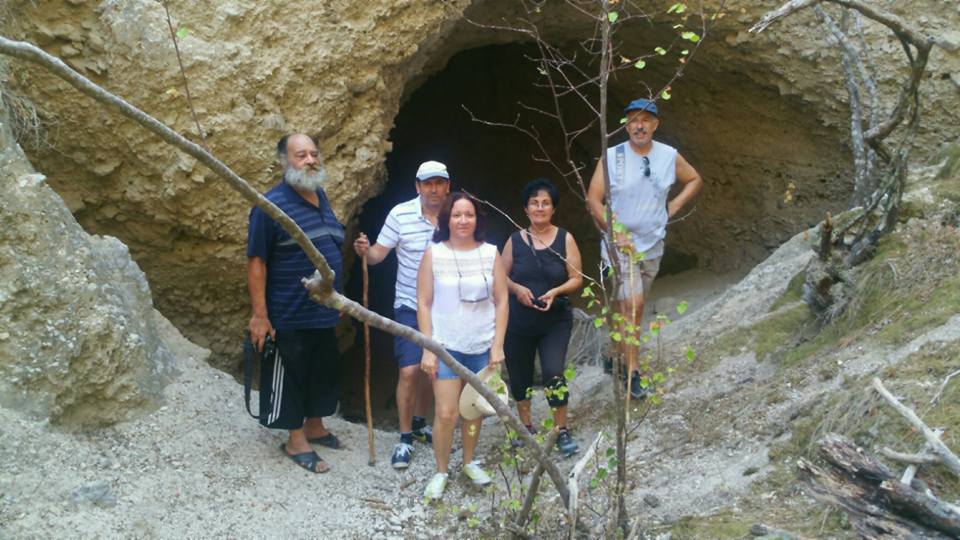
Ο Γερόσπηλιος στο χωριό Ακανθού - Gerospilios at Akanthou Village Cyprus
Many thanks to Iliada Pasatou Skoutari
Ο Γερόσπηλιος είναι ένα φυσικό σπήλαιο, τούνελ με βάθος 70 μέτρα περίπου και ύψος 8 με 10 μέτρα. Εχει δύο στόμια, εισόδου και εξόδου. Από το εσωτερικό του σπηλαίου διαπερνά ο ομώνυμος ποταμός Γερόσπηλιος. Είναι φωλιά για νυχτερίδες και άγρια περιστέρια. Κατά την περίοδο του απελευθερωτικού αγώνα της ΕΟΚΑ υπήρξε καταφύγιο για τους αγωνιστές και κρυψώνα για τον οπλισμό τους.
Κείμενο Iliada Pasatou Skoutari
Photos 11/8/2016 by George Konstantinou
Photos 11/8/2016 Iliada Pasatou Skoutari
see also
Εκκλησία του Αγίου Χαραλάμπου στην Ακανθού .
Ετικέτες
Caves of Cyprus,
Landscape of Cyprus
Holothuria (Platyperona) - Sanctori Delle Chiaje, 1823 - Sea cucumber - Ολοθούριο - Cyprus

Holothuria is a genus of marine animals of the family Holothuriidae. Members of the genus are found in coastal waters in tropical and temperate regions. They are soft bodied, limbless invertebrates that dwell on the ocean floor. They resemble a cucumber in form.The genus contains some species that are harvested for food and sold as sea cucumber.
Cavo Greco,09.08.2016.Photos by Costas Constantinou
Underwater photo At Mandria 18/12/2016 by Kostas Aristeidou
Sea cucumbers are echinoderms from the class Holothuroidea. They are marine animals with a leathery skin and an elongated body containing a single, branched gonad. Sea cucumbers are found on the sea floor worldwide. The number of holothurian species worldwide is about 1,717 with the greatest number being in the Asia Pacific region. Many of these are gathered for human consumption and some species are cultivated in aquaculture systems. The harvested product is variously referred to as trepang, bêche-de-mer or balate. Sea cucumbers serve a useful role in the marine ecosystem as they help recycle nutrients, breaking down detritus and other organic matter after which bacteria can continue the degradation process.Like all echinoderms, sea cucumbers have an endoskeleton just below the skin, calcified structures that are usually reduced to isolated microscopic ossicles (or sclerietes) joined by connective tissue. In some species these can sometimes be enlarged to flattened plates, forming an armour. In pelagic species such as Pelagothuria natatrix (Order Elasipodida, family Pelagothuriidae), the skeleton is absent and there is no calcareous ring.
The sea cucumbers are named after their resemblance to the fruit of the cucumber plant.
Most sea cucumbers, as their name suggests, have a soft and cylindrical body, more or less lengthened, rounded off and occasionally fat in the extremities, and generally without solid appendages. Their shape ranges from almost spherical for "sea apples" (genus Pseudocolochirus) to serpent-like for Apodida or the classic sausage-shape, while others resemble caterpillars. "The mouth is surrounded by tentacles, which can be pulled back inside the animal."[6] Holothurians measure generally between 10 and 30 centimeters long, with extremes of some millimeters for Rhabdomolgus ruber and up to more than 3 meters for Synapta maculata. The largest American species, Holothuria floridana, which abounds just below low-water mark on the Florida reefs, has a volume of well over 500 cubic centimeters (31 cu in), and 25–30 cm (10–12 in) long. Most possess five rows of tube feet (called "podia"), but Apodida lacks these and moves by crawling; the podia can be of smooth aspect or provided with fleshy appendages (like Thelenota ananas). The podia on the dorsal surface generally have no locomotive role, and are transformed into papillae. At one of the extremities opens a rounded mouth, generally surrounded with a crown of tentacles which can be very complex in some species (they are in fact modified podia); the anus is postero-dorsal.
Holothurians do not look like other echinoderms at first glance, because of their tubular body, without visible skeleton nor hard appendixes. Furthermore, the fivefold symmetry, classical for echinoderms, although preserved structurally, is doubled here by a bilateral symmetry which makes them look like chordates. However, a central symmetry is still visible in some species through five 'radii', which extend from the mouth to the anus (just like for sea urchins), on which the tube feet are attached. There is thus no "oral" or "aboral" face as for sea stars and other echinoderms, but the animal stands on one of its sides, and this face is called trivium (with three rows of tube feet), while the dorsal face is named bivium. A remarkable feature of these animals is the "catch" collagen that forms their body wall.This can be loosened and tightened at will, and if the animal wants to squeeze through a small gap, it can essentially liquefy its body and pour into the space. To keep itself safe in these crevices and cracks, the sea cucumber will hook up all its collagen fibers to make its body firm again.
The most common way to separate the subclasses is by looking at their oral tentacles. Order Apodida have a slender and elongate body lacking tube feet, with up to 25 simple or pinnate oral tentacles. Aspidochirotida are the most common sea cucumbers encountered, with a strong body and 10–30 leaf like or shield like oral tentacles. Dendrochirotida are filter-feeders, with plump bodies and 8–30 branched oral tentacles (which can be extremely long and complex).
From https://en.wikipedia.org/wiki/Sea_cucumber
Wednesday, 10 August 2016
Orange cleaner shrimp - Stenopus spinosus Risso, 1827 - Cyprus

Stenopus spinosus is a shrimp-like decapod crustacean belonging to the infraorder Stenopodidea.Stenopus spinosus can grow up to 8 centimetres (3.1 in) long, and is chiefly yellow, with white antennae and white tips to the chelae (claws). The uropods and telson have red tips
Stenopus spinosus is commonly found in shallow waters in the Mediterranean Sea, and at greater depths in adjacent parts of the Atlantic Ocean. It is frequently encountered on night dives in parts of its range. A record of S. spinosus from the Red Sea proved to be a different species, Engystenopus spinulatus.
From Wikipedia, the free encyclopedia
Cavo Greco,09.08.2016.Photos by Costas Constantinou
Potter wasps.- Rhynchium oculatum (Fabricius, 1781) - Cyprus
Rhynchium is an Australian, Afrotropical, Indomalayan and Palearctic genus of potter wasps.
Photos Nicosia by George Konstantinou
Family: Vespidae
Sub family: Eumeninae (has approximately 3000 associated species in the world).
Maximum size 30 mm
A widespread species, found mainly around the warmer Mediterranean Countries of Europe and into North Africa; reaching over to the far eastern countries of Iran and neighbouring countries.
R. oculatum, is a large solitary Potter wasp, having an important part in the biological control of many lepidoptera (Geometridae, Tortricidae) Caterpillars, also Coleoptera, (Curculionidae, Chrysomelidae) Larvae of Beetles, which are preyed upon, to provide provisions for their young larvae.
The prey is paralised, then taken to her nesting site, usually the nest is found in decaying wooden holes and crevices, sealed with mud.
This wasp is beneficial to commercial growers and gardeners, as like most wasps, they are a natural biocontrol of garden pests, such as beetle larvae, flies and a variety of caterpillar pests.
Habitat: Many various locations, from dry scrub areas to rich meadows, grasslands, orchards, crop fields, urban gardens and wetlands, wherever their prey and nectar plants are to be found.
A variety of plants are visited by the adult wasp for pollen and nectar, Plants belonging to the Euphorbiaceae (Spurge Family), Asteraceae (particularly the hardy common Ragwort) and Apiaceae family (mainly parsley) seem to be mostly favoured.
Rhynchium oculatum is not considered to be aggressive, but If the wasp feels threatened, especially near a nesting site, they will not hesitate to protect their larvae. A sting can be very painful from this wasp and like all venomous animals, a sting can produce a potentially anaphylactic (allergic) reaction for some people. Don’t forget unlike most insects, a wasp can sting multiple times! From https://www.wildlifenatural.com/Insects-in-Spain/Rhynchium-oculatum/
Rhynchium oculatum (Fabricius, 1789)
Οικογένεια: Vespidae
Υποοικογένεια: Eumeninae (έχει περίπου 3000 σχετικά είδη στον κόσμο).
Μέγιστο μέγεθος 30 mm
Είδος ευρέως διαδεδομένο, που απαντάται κυρίως γύρω από τις θερμότερες μεσογειακές χώρες της Ευρώπης και στη Βόρεια Αφρική. φτάνοντας στις ανατολικές χώρες του Ιράν και στις γειτονικές χώρες.
Το R. oculatum, είναι μια μεγάλη μοναχική σφήκα Πότερ, που έχει σημαντικό ρόλο στον βιολογικό έλεγχο πολλών λεπιδόπτερων (Geometridae, Tortricidae) Caterpillars, επίσης Coleoptera, (Curculionidae, Chrysomelidae) Προνύμφες των σκαθαριών, τα οποία θηρεύονται για την παροχή προμήθειας τις νεαρές προνύμφες τους.
Το θήραμα παραλύεται, στη συνέχεια μεταφέρεται στο σημείο φωλεοποίησης του, συνήθως η φωλιά βρίσκεται σε σάπιες ξύλινες τρύπες και σχισμές, σφραγισμένες με λάσπη.
Αυτή η σφήκα είναι ωφέλιμη για τους εμπορικούς καλλιεργητές και τους κηπουρούς, καθώς όπως οι περισσότερες σφήκες, αποτελούν φυσικό βιοέλεγχο των παρασίτων του κήπου, όπως οι προνύμφες σκαθαριών, οι μύγες και μια ποικιλία παρασίτων κάμπιας.
Βιότοπος: Πολλές διάφορες τοποθεσίες, από ξηρές θαμνώδεις περιοχές μέχρι πλούσια λιβάδια, λιβάδια, οπωρώνες, χωράφια, αστικούς κήπους και υγροτόπους, όπου κι αν βρίσκονται τα θηράματά τους και τα φυτά νέκταρ.
Η ενήλικη σφήκα επισκέπτεται μια ποικιλία φυτών για γύρη και νέκταρ, Φυτά που ανήκουν στα Euphorbiaceae (Οικογένεια Spurge), Asteraceae (ιδιαίτερα το ανθεκτικό κοινό Ragwort) και Apiaceae (κυρίως μαϊντανός) φαίνεται να ευνοούνται περισσότερο.
Το Rhynchium oculatum δεν θεωρείται επιθετικό, αλλά εάν η σφήκα αισθανθεί ότι απειλείται, ειδικά κοντά σε ένα σημείο φωλεοποίησης, δεν θα διστάσει να προστατεύσει τις προνύμφες της. Ένα τσίμπημα μπορεί να είναι πολύ επώδυνο από αυτή τη σφήκα και όπως όλα τα δηλητηριώδη ζώα, ένα τσίμπημα μπορεί να προκαλέσει μια δυνητικά αναφυλακτική (αλλεργική) αντίδραση για μερικούς ανθρώπους. Μην ξεχνάτε, σε αντίθεση με τα περισσότερα έντομα, μια σφήκα μπορεί να τσιμπήσει πολλές φορές!
Telmatactis cricoides ,(Duchassaing, 1850) lub tipped anemone - Cyprus
Indian Ocean twospot cardinalfish - Cheilodipterus novemstriatus (Rüppell, 1838) - Cyprus
L

Cheilodipterus novemstriatus, the Indian Ocean twospot cardinalfish, is a species of ray-finned fish from the Indian Ocean, which is a member of the family Apogonidae. It has colonised the eastern Mediterranean Sea by way of the Suez Canal since 2011
Cheilodipterus novemstriatus has a slender body with a short snout, a terminal mouth which has canine-like teeth in both jaws. although there are no teeth at the symphysis of the lower jaw, and a large eye. There are two dorsal fins, the origin of the first dorsal fin is slightly behind the origin of the pelvic fin. The anal fin is in line with the second dorsal fin and the caudal fin is forked. The body is an overall silver-grey in colour with five contrasting, longitudinal black stripes with the upper running near the base of the dorsal fin. The middle or third stripe starts at the snout running through the eye to the caudal peduncle, while the lower stripe runs along ventral surface in an arc which terminates in front of the base of the pectoral fin, the portion of this stripe often becomes indistinct towards the base of the anal fin. The caudal peduncle has a large oval black spot which is surrounded by yellow background on the caudal peduncle and a second black spot is located on the dorsal surface of caudal peduncle. It is a small species reaching a maximum length of 8 centimetres (3.1 in) but more commonly measures 2–6 cm (0.79–2.36 in) in length.Cheilodipterus novemstriatus is native to the western Indian Ocean from the Red Sea to the Persian Gulf. In 2011 it was recorded in the Mediterranean Sea off Israel, then in Lebanon in 2012 and off south eastern Turkey in 2014, it is now established in the Levantine Sea, the most likely route for this invasion is by Lessepsian migration from the Red Sea via the Suez Canal
Cheilodipterus novemstriatus is describes as common in shallow, sheltered waters[3] and is found at depths of 1-10m over rocky reefss or coral which have holes and ledges. It will shelter among the spines of sea urchins of the genus Diadema in groups of as many as 30 individuals, although this depends on the relative sizes of the urchin to that of the fishes. It has also been recorded from a shipwreck at a depth of 30m in the Mediterranean, where it was sympatric with the indigenous Mediterranean cardinalfish Apogon imberbis, it has also been recorded on hard substrates covered with calcareous algae, near rocky crevices and overhangs. It has been recorded sheltering alongside juveniles of the native wrasse Coris julis.
Cheilodipterus novemstriatus is nocturnal and emerges from its daytime shelters to feed in more open areas, its nocturnal habits may have facilitated its successful invasion of the eastern Mediterranean as there are few indigenous nocturnal competitors. Its main food is zooplankton and in the Red Sea it is frequently encountered at night along sandy shores at depths of 0.5-1.5 m. It is a sociable species and gathers in large groups, especially in its daytime shelters and even in the newly established Mediterranean populations large schools have been encountered. Like other species of cardinal fish C novemstriatus show pairing behaviour and courtship and the male broods the eggs in his mouth
From https://en.wikipedia.org/wiki/Cheilodipterus_novemstriatus
Photos by Costas Constantinou
Subscribe to:
Posts (Atom)