Translate

Wednesday, 12 August 2015

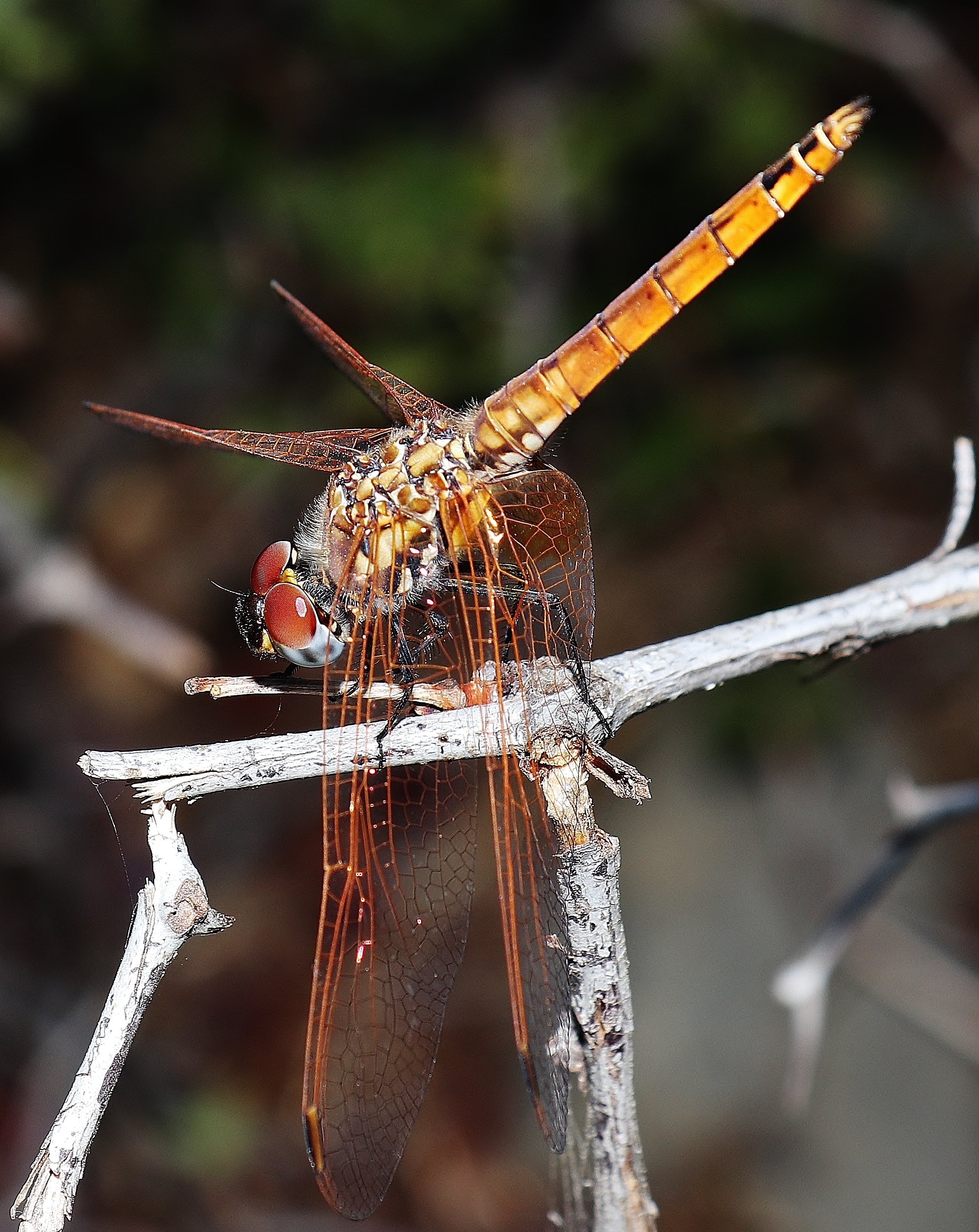
Violet dropwing, Violet-marked darter, Purple-blushed darter or Plum-coloured dropwing -Trithemis annulata (Beauvois, 1807) - Cyprus


Trithemis annulata, known commonly as the violet dropwingviolet-marked darterpurple-blushed darter or plum-coloured dropwing, is a species of dragonfly in the family Libellulidae. It is found in most of Africa, in the Middle East, in the Arabian Peninsula and southern Europe. These insects are called dropwings because of their habit of immediately lowering their wings after landing on a perch. Males of this species are violet-red with red veins in the wings while females are yellow and brown. Both sexes have red eyes.
Trithemis annulata is a robust medium-sized species with a wingspan of 60 mm (2.4 in). The mature male has a dark red head and a yellow labium with brown central spot. The eyes are red with white spots on the rear edge, and the frons is dark metallic purplish-red. Theprothorax is violet with slightly darker longitudinal stripes. The membranous wings have distinctive red veins, the pterostigma is orange-brown and there is a large orange-brown splash at the base of the hind wings. The abdomen is fairly broad and is pinkish-violet, with purple markings on the top of each segment and blackish markings on the terminal three segments. Females are a similar size to males but the thorax is brownish and the abdomen is yellow with dark brown markings. The wings of females lack the red veins of males but have similar orange-brown patches. It is very similar in appearance to the red-veined dropwing (Trithemis arteriosa), but that species has a more slender abdomen and a wedge-shaped black area on either side of the tip of the abdomen.
Trithemis annulata is an adaptable species, and the adults are able to tolerate a range of habitats including semi-arid rangeland. They can be seen flying near sluggish rivers, in marshes and also beside still-water ponds. They are sometimes seen in brackish water habitats, although it is unclear whether they actually breed in salty water. The larvae develop rapidly, so these dragonflies are able to make use of temporary water bodies for breeding. Males are often to be seen perching on the twigs of waterside shrubs and on rocks in the sunshine, but in the evening or when the sun is obscured, they move into trees.
The female T. annulata is thought to deposit her eggs by flying over the surface and dipping the tip of her abdomen in the water. The larvae develop in water where they are aggressive predators. The adults are also predators, using their excellent eyesight to detect prey and their legs to hold and carry their victims. From Wikipedia, the free encyclopedia
Photos Nicosia by George Konstantinou


Broad scarlet, Common scarlet-darter, Scarlet darter and Scarlet dragonfly - Crocothemis erythraea (Brullé, 1832) - Cyprus


Crocothemis erythraea is a species of dragonfly in the genus Crocothemis. Its common names include broad scarletcommon scarlet-darterscarlet darter and scarlet dragonfly
The adult male scarlet dragonfly has a bright scarlet red, widened abdomen, with small amber patches at the bases of the hindwings. Females and immatures are yellow-brown and have a conspicuous pale stripe along the top of the thorax
The scarlet dragonfly is a common species in southern Europe and north Africa. It is recorded from every country in Africa and occurs across Asia as far as southern China. From Wikipedia, the free encyclopedia
Photos Kuklia Amochostou, 13/7/2015 by George Konstantinou


Cottony cushion scale - Icerya purchasi (Maskell,1878) Βαμβακάδα των εσπεριδοειδών - Cyprus

Family: Monophlebidae

Icerya purchasi (common namecottony cushion scale) is a scale insect that feeds on more than 50 families of woody plants, most notably on Citrus and Pittosporum. Originally described in 1879 from specimens collected in New Zealand as pests of kangaroo acacia, it is now found worldwide where citrus crops are grown. The cottony cushion scale originates from Australia.
This scale infests twigs and branches. The mature hermaphrodite is oval in shape, reddish-brown with black hairs, 5 mm long. When mature, the insect remains stationary, attaches itself to the plant by waxy secretions, and produces a white egg sac in grooves, by extrusion, in the body which encases hundreds of red eggs. The egg sac will grow to be two to three times as long as the body. Newly hatched nymphs are the primary dispersal stage, with dispersion known to occur by wind and by crawling. Early stage nymphs feed from the midrib veins of leaves and small twigs, and do the bulk of the damage. At each molt, they leave at the old feeding point the former skin and the waxy secretions in which they had covered themselves and from which their common name is derived. Unlike many other scale insects, they retain legs and a limited mobility in all life stages. Older nymphs migrate to larger twigs and eventually as adults to branches and the trunk. Their life cycle is highly temperature dependent, as the length of time in each stage of life is longer in cold temperatures than high temperatures.
True males are uncommon to rare overall, and in many infestations are not present. Pure females are unknown. Self-fertilization by a hermaphrodite will produce only hermaphrodites. Matings of a male and hermaphrodite will produce both males and hermaphrodites.
In addition to the direct damage from sap sucking, the insects also secrete honeydew, on which sooty mold often grows and causes further damage to the host plant. Some ants will also consume this honeydew.From Wikipedia, the free encyclopedia
Photos Athalassa, 25/10/2014 by George Konstantinou


Fig wax scale - Ceroplastes rusci (Linnaeus, 1758) - (Insecta: Hemiptera: Coccoidea: Coccidae) - Cyprus

Ceroplastes is a genus of wax scales in the family Coccidae. There are more than 130 described species in Ceroplastes

This scale is deeply encased in pinkish-gray wax, which is divided into three wax plates on each side with additional plates at the anterior and posterior ends. The single large dorsal plate has a central nucleus. Dorsal and lateral plates are separated from each other by dark red lines which are the color of the scale's body beneath the wax. The anterolateral and mediolateral plates have some white wax which indicates the stigmatic wax bands.
The biology of the fig wax scale has not been studied in Florida but has been described on fig trees in Israel (Bodkin 1927). In general, adult females overwinter on twigs and produce eggs very early in the spring. The eggs hatch to crawlers which move to feed on leaves. After about one month, the crawlers molt to 2nd instar nymphs and migrate to the leaf petioles or to new shoots. Maturity is attained in the summer, and a new generation of crawlers is produced. These nymphs mature late in the fall, overwinter on the twigs, and repeat the cycle (Bodkin 1927). Swailem and Awadallah (1973) reported scales to be equally present on both upper and lower leaf surfaces on fig trees in Egypt.

Talhouk (1975) reported the presence of this scale in the Mediterranean region (Algeria, Cyprus, Egypt, Greece, Israel, Italy, Lebanon, Morocco, Spain, Tunisia and Turkey) and Argentina.
 From https://entnemdept.ufl.edu/creatures/orn/scales/fig_wax_scale.htm

Photos Dali, 31/10/2014 by George Konstantinou


Termites - Τερμίτες - Cyprus


Termites are a group of eusocial insects that were classified at the taxonomic rank of order Isoptera (see taxonomy below), but are now classified either as the infraorder Isoptera, or as epifamiliy Termitoidae within the cockroach order Blattodea. While termites are commonly known, especially in Australia, as "white ants," they are not closely related to the ants.
Like ants, and some bees and wasps — all of which are placed in the separate order Hymenoptera — termites divide labor among castes, produce overlapping generations and take care of young collectively. Termites mostly feed on dead plant material, generally in the form of wood, leaf litter, soil, or animal dung, and about 10% of the estimated 4,000 species (about 3,106 taxonomically known) are economically significant as pests that can cause serious structural damage to buildings, crops or plantation forests. Termites are major detritivores, particularly in the subtropical and tropical regions, and their recycling of wood and other plant matter is of considerable ecological importance.
As eusocial insects, termites live in colonies that, at maturity, number from several hundred to several million individuals. Termites communicate during a variety of behavioral activities with signals. Colonies use decentralised, self-organised systems of activity guided by swarm intelligence which exploit food sources and environments unavailable to any single insect acting alone. A typical colony contains nymphs (semimature young), workers, soldiers, and reproductive individuals of both genders, sometimes containing several egg-laying queens..From Wikipedia, the free encyclopedia


Photos Athalassa, 9/1/2015 by George Konstantinou
Photos Agia Triada - Video Akanthou by Michael Hadjiconstantis


Fleas - Siphonaptera (Latreille,1825) - Ψύλλος - Cyprus

Fleas are insects that form the order Siphonaptera. They are wingless, with mouth parts adapted for piercing skin and sucking blood. Fleas are external parasites, living by hematophagy off the blood of mammals and birds..From Wikipedia, the free encyclopedia
Photos by George Konstantinou


Black rat – Rattus rattus (Linnaeus, 1758) Ποντίκα ή Μαύρος αρουραίος - Cyprus

 See also

Λίστα των θηλαστικών της Κύπρου - List of mammals of Cyprus


Τρωκτικά: Τα πιο μισητά θηλαστικά της Κύπρου - Του Γιώργου Κωνσταντίνου - Εφημερίδα πολίτης 3/11/2019


The black rat (Rattus rattus, also known as the ship ratroof rathouse ratAlexandrine ratold English rat, and other names) is a common long-tailed rodent of the genus Rattus (rats) in the subfamily Murinae (murine rodents). The species originated in tropical Asia and spread through the Near East in Roman times before reaching Europe by the 1st century and spreading with Europeans across the world.
Black rats are generalist omnivores. They are serious pests to farmers as they eat a wide range of agricultural crops.From Wikipedia, the free encyclopedia
Photos Latsia  by George Konstantinou


Lesser White-toothed Shrew - Crocidura suaveolens cypria (Pallas, 1811) - Μυγαλή - Cyprus

Endemic to Cyprus
The Lesser White-toothed Shrew (Crocidura suaveolens) is a tiny shrew with a widespread distribution in Africa, Asia and Europe.Its preferred habitat is scrub and gardens and it feeds on insects, worms, slugs, snails, newts and small rodents. The closely related Asian Lesser White-toothed Shrew (Crocidura shantungensis) was once included in this species, but is now considered to be a separate species.
Like the common shrew, a female lesser white-toothed shrew and her young may form a "caravan" when foraging for food or seeking a place of safety; each shrew grips the tail of the shrew in front so that the group stays together
Occurs widely from France and Spain, in the west, across Europe and Asia to Japan and also in North Africa. There is one isolated United Kingdom population in the Isles of Scilly and another two populations off the French coast in the Channel Islands of Jersey and Sark. The preferred habitat is dry ground, including scrub and gardens, and within the Isles of Scilly can be found on shingle beaches and sand dunes.From Wikipedia, the free encyclopedia
Photos and video Geri ,16/4/2015 by George Konstantinou


Tuesday, 11 August 2015

Baizongia pistaciae (Linnaeus) - Aphids - Cyprus

Family: Aphididae
Baizongia pistaciae [L.] induces galls on Pistacia palaestina or in Pistacia terebinthus, in the Mediterranean region. Its galls are very big and populated by thousands of female aphids, forming a clone created by a single mother.
Gall insects are parasitic herbivores that not only consume plant resources, but also induce physiological and morphological changes in plant tissue. These growth transformations are the
result of both the stimulus of the gall-inducer and the reactions of the plants (Tscharnke 1989; Wool 1997). Galls in plants are defined as pathologically developed cells, tissues or organs that have arisen by hypertrophy (increase in cell size) and/or by hyperplasia (increase in cell number), following the
stimulation from a foreign organism.

Gall-inducing species are a minority among aphids: less than 10 percent of the 4,401 aphid species listed by Blackman and Eastop (1994) are considered gall inducers. These species are the subject of researches meanly in USA, Japan, England and Israel (Wool, 2003).

In Israel and the region around, 16 species creates galls on three different Pistacia trees:  eight on Pistacia atlantica Desf., seven on Pistacia palaestina Boiss. and only one on Pistacia lentiscus L.
The biggest galls are created by Baizongia pistaciae [L.], which parasites apical buds of P. palaestina. These galls form perfectly closed pouches with a volume of tens of milliliters, which may contain thousands of aphids, representing four generations of descendants of a single female fundatrix. The geographic distribution of these aphids around the Mediterranean Basin, from Morocco and Spain east to Iran, corresponds with that of the host trees (Bodenheimer and Swirski 1957; Davatchi 1958, Zohary, 1952).

The life cycle (holocyclic – with an obligatory sexual phase) of B. pistaciae lasts two years. Several generations of parthenogenic reproduction are interrupted by a single sexual generation. This involves
alternation between the primary host (Pistacia trees) used by active aphids during spring and summer, and the roots of various Poaceae (grasses and cereals) as secondary hosts in fall and winter. Host alternation is accomplished by winged aphids: in autumn, following desiccation and opening of
the galls on Pistacia trees, fall migrants disperse on the ground where they reproduce and conquer root grasses. In the next spring, migrants fly from overwintering colonies on the secondary hosts to the primary ones and deposit the sexual generation. These mate and lay overwintering eggs from which gall fundatrices hatch the following spring. They produce new galls in young apical buds that serve as incubators in which the single fundatrix reproduces parthenogenetically, resulting in a clone of thousands of genetically identical offspring (Wool 1995). During migration from host to host, a part of the winged aphids actively fly to neighbor plants, while others are carried along by winds. Among the latter, mortality may reach very high level. Using genetic tools, Martinez et al. (2005) indirectly showed that survival and, as a consequence, production of offspring are higher in aphids flying to
near hosts than in individuals transported far away by winds.

B. pistaciae is a specialist: it creates galls only on P. palaestina or in Pistacia terebinthus. P. palaestina is now considered as a variety of P. terebinthus (Kafkas and Perl-Treves 2001; Kafkas 2006). This aphid is unable to establish on other Pistacia species like atlantica or lentiscus.
Its galls are found in greater number in trees growing in disturbed habitats like roadsides (Martinez & Wool, 2006), or in transitional zones (ecotones) between closed Mediterranean forests and open landscape. It parasites more often old trees than young ones, and shrub-like individuals than tree-like ones (Martinez et al., 2005).

Authors - Martinez Jean Jacques Itzhak

Photos Kornos ,8/11/2014 by George Konstantinou

See also

Seven-spot ladybird - Coccinella septempunctata (Linnaeus, 1758) Πασχαλίτσα - Cyprus

 Family Coccinellidae
Coccinella septempunctata, the seven-spot ladybird (or, in North Americaseven-spotted ladybug or "C-7"), is the most common ladybird in Europe. Its elytra are of a red colour, but punctuated with three black spots each, with one further spot being spread over the junction of the two, making a total of seven spots, from which the species derives both its common and scientific names (from the Latin septem = "seven" and punctus = "spot").
C. septempunctata has a broad ecological range, living almost anywhere there are aphids for it to eat. Both the adults and the larvae are voracious predators of aphids, and because of this, C. septempunctata has been repeatedly introduced to North America as a biological control agent to reduce aphid numbers, and is now established in North America, and has been subsequently designated the official state insect of five different states (Delaware, Massachusetts, New Hampshire, Ohio, and Tennessee).
In the United Kingdom, there are fears that the seven-spot ladybird is being outcompeted for food by the harlequin ladybird. Conversely, in North America, this species has outcompeted many native species, including other Coccinella.
An adult seven-spot ladybird may reach a body length of 7.6–10.0 mm (0.3–0.4 in). Their distinctive spots and attractive colours apparently make them unappealing to predators. The species can secrete a fluid from joints in their legs which gives them a foul taste. A threatened ladybug may both play dead and secrete the unappetising substance to protect itself. The seven-spot ladybird synthesizes the toxic alkaloids, N-oxide coccinelline and its free base precoccinelline; depending on sex and diet, the spot size and coloration can provide some indication of how toxic the individual bug is to potential predators.
From Wikipedia, the free encyclopedia
Photos Geri ,21/10/2014 by George Konstantinou


Trichomeloe chrysocomus (Miller, 1861) - Oil beetle - Cyprus


Trichomeloe is a genus of beetles in the oil beetle family Meloidae.  The genus was first scientifically described in 1911 by Reitter.

Trichomeloe chrysocomus in Europe is present only in Cyprus.

They are known as "oil beetles" because they release oily droplets of hemolymph from their joints when disturbed; this contains cantharidin, a poisonous chemical causing blistering of the skin and painful swelling. Members of this genus are typically flightless, without functional wings, and shortened elytra.
As in other members of the family, they are hypermetamorphic, going through several larval stages, the first of which is typically a mobile triungulin that finds and attaches to a host in order to gain access to the host's offspring. In this genus, the host is a bee, and each species of Meloidae may attack only a single species or genus of bees; while sometimes considered parasitoids, it appears that in general, the Meloidae larva consumes the bee larva along with its provisions, and can often survive on the provisions alone, thus they do not truly qualify (see Parasitoid for definition).From Wikipedia, the free encyclopedia
Photos  Kormakitis ,25/1/2015 by George Konstantinou