Cyprus naturalist at home with other animals
 The elephant – unlike the snake and scorpion – isn’t real, of course; it’s around two dozen elephant fossils, arranged on the wall in the approximate shape of the beasts they once belonged to. George’s collection of fossils is even more extensive than his collection of sea shells, indeed he says it numbers in the millions – which sounds unlikely but it’s possible, given that he’s spent decades going out into Nature on a daily basis. “There are very few things in Cyprus which my eyes haven’t seen,” he tells me. A mutual friend has already mentioned how she’ll send George a photo if she sees some unusual insect in her house or garden – and he’ll invariably reply in a couple of minutes, with its Latin name and general habits.
That’s impressive, but it’s not the whole story. Knowing every species of animal, insect, bird, plant – even fish; he used to be a freediver – on the island is a huge accomplishment, then again experts exist in all walks of life. What’s amazing about George Konstantinou isn’t just his knowledge but his temperament, his personality, his obsessive nature – even to the point of being self-destructive – and the expansive scope of his ambition. The small house in Geri houses not just fossils (so many fossils “you could set up a museum of natural history of Cyprus”) and reptiles in jars, it’s also where he spends many hours on his magnum opus, an all-encompassing online encyclopaedia of our heritage and biodiversity.
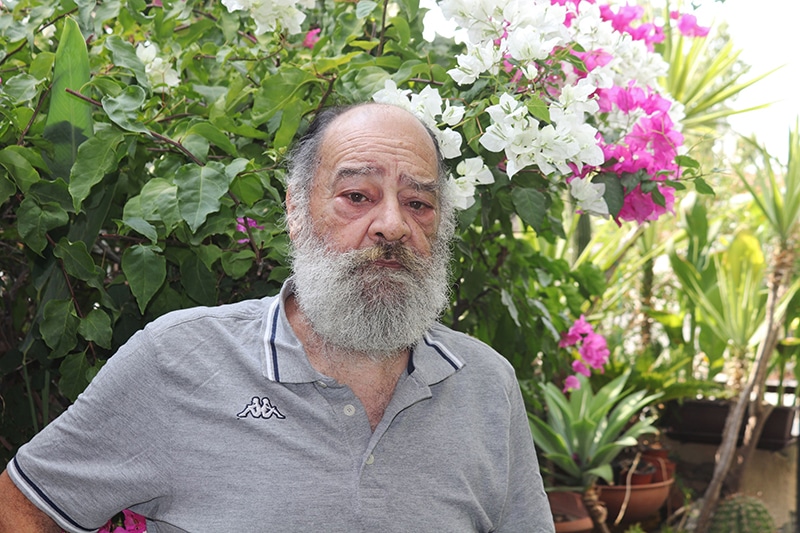
He’s a doleful-looking man, naturally gruff but not unfriendly. His bushy beard is grey, flecked with yellow around the lips; his fingers are stained with tobacco. “You won’t find me even two minutes without a cigarette,” he admits, chain-smoking roll-ups while talking to me and watching National Geographic on TV. “A friend of mine shot that!” he exclaims suddenly, pointing to a clip of a blunt-nosed viper (our only dangerous snake that’s native to Cyprus) biting a heron and refusing to let go; all the big channels apparently trawl YouTube looking for clips, then email creators for permission. (One of his own nature videos, a 15-second clip, was on BBC Earth a few days ago.) It’s mid-afternoon, on a grey cloudy Thursday; any day is fine, said George over the phone, but it has to be after 12 o’clock – I’d assumed because he works in the mornings, but in fact it’s because he sleeps. “What time did I go to bed today?” he asks his wife.
“In the morning,” shrugs Fani.
 “8am!” he reports triumphantly. “I was working on the website. And not just last night. I’m giving you today as an example, but it’s the same every day.” He’ll work 15 hours (“20 hours, if you can believe it”) on his various projects, a bit less in winter but only because he makes up the difference by going out on field trips. It’s a life that would test the stamina even of a man in good health – but in fact George’s health isn’t good. He’s now 63; at 30 he came down with diabetes, out of nowhere and without any family history to serve as a warning – a disease which, left unchecked, gradually wears down the organs. He had his first heart attack in his early 50s. “I had another one last September which destroyed 70 per cent of my heart. I had to put in a pacemaker.”
Smoking cigarettes and pulling all-nighters doesn’t sound like the best idea for a man with a dodgy heart. Shouldn’t he be taking better care of himself? “Yeah, but I can’t,” he replies. “I want to finish what I’m doing.”
Well, isn’t he afraid of death?
“No, not at all,” he says instantly, having presumably become quite familiar with the circle of life through his forays in the natural world. (“This scene you’re seeing now, I’ve seen hundreds of times,” he says at one point, as National Geographic plays a clip of an eagle swooping down on its prey.) “I’m ready to go. I’ve seen what I’ve seen [in my life], I’m very happy. Besides, I always said to myself, ‘If I make it to 60, I’ll be happy’. I’m 63 now, so this is just gravy.”
His family (he and Fani have three kids, two sons and a daughter) may wish he were less fatalistic; then again, George also strikes me as the kind of person who won’t be moved, once he makes up his mind about something. He was always unusual, stubbornly himself – and he always had the obsession with Nature, “from the time I was born… My first solo outing was when I was two, my mum came and found me in a wet flowerbed, holding an earthworm and studying it”. He calls it a “gene”, meaning he was born with it – but in fact that’s a misnomer because nobody else in the family (originally from Taktakalas in Nicosia, which they fled after the troubles in 1963) shared his interest in flora and fauna.
“They thought I was nuts,” he recalls of his parents. “I’d go to school and my pockets would be full of snakes, frogs, lizards. I’d put them in my satchel, sometimes they’d escape in the classroom…” The parents never understood – even though his dad came from a village (Gerakies) and had grown up surrounded by Nature. “I might be holding something – something harmless, I mean – and they’d get scared and start yelling. Which is usually what happens with people”. This is a constant refrain in our conversation, ignorant normies who refuse to “understand the value of biodiversity, or to learn about dangerous species and when they’re dangerous” and lash out at every perceived threat, however ludicrous. “Someone sees a cockroach and starts screaming. What’s a cockroach going to do to you? This is a phobia, handed down by the parents.”
Snakes are a good example, he goes on, and I sneak a glance at the plastic jar inches away from my feet. (The snake and scorpion were collected from private homes; the cops have his phone number, and will call George when someone reports an animal sighting so he can pick up the intruder and set it free during his next field trip.) Snakes are a good example of popular prejudice, he repeats: “It’s so easy! We’ve got eight or nine species, just do some research to know which ones are dangerous, look at some photos so you can recognise them. It’s easy – but they panic, and just kill whatever they see.” The irony is that only one species, the aforementioned blunt-nosed viper, actually has a poisonous bite (two others are also poisonous, but the fangs are at the back of the throat and the venom is only applied as they swallow their prey) – yet even George’s own grandpa, who again grew up in a village, had an irrational fear of serpents: “He’d see me handling a snake and say, ‘You’re going to get yourself killed one day, doing things like that’…” George shakes his head: “Ignorance!”.

Cypriots’ alienation from natural rhythms is a constant source of frustration. Snakes eat rats, so a snake goes into a garden to eat a rat – but the homeowner panics and kills the snake, meaning he then has to put down rat poison which also kills lots of other animals. Or take vultures, which are almost extinct in Cyprus (“We only have about 15 vultures now”); farmers put poison on animal carcasses to kill foxes, vultures swoop down on the carcass and are decimated en masse. “Idiocy!” fumes George. “Ignorance and lack of education. Here, for instance,” he goes on, gesturing vaguely to indicate Geri, “they found a chameleon on the road – the most harmless animal we have in Cyprus – and everyone gathered with rakes and shovels to kill it. I mean, come on.”
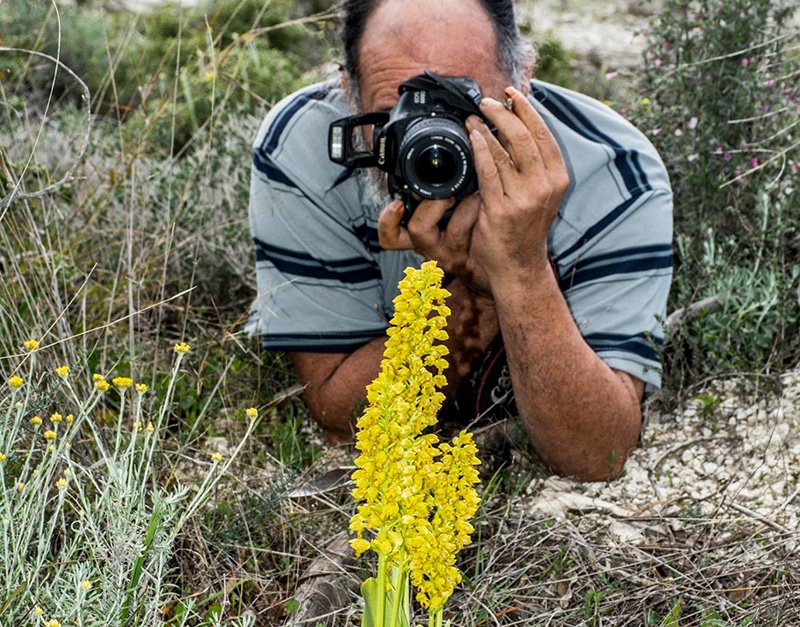
These are all good stories – but, again, they don’t quite capture the force of his character, or the scale of his single-mindedness. It’s not just that he knows a lot about biodiversity, it’s also that he gave up his life (and continues to do so, even at the cost of his health) in pursuit of these things. He has no use for money, he assures me, and dislikes city life at the best of times, so for many years – spurred on perhaps by the diabetes, and a sense of time running out – he’d spend almost every day exploring, taking photos, collecting fossils. He had to do it, impelled by some urge to know everything. “For instance, I wanted to see all the butterflies of Cyprus. We have 53 kinds of butterfly, I wouldn’t rest till I’d found them all… Then, for instance, orchids. We have 41 kinds of orchids, I wanted to find them all”.
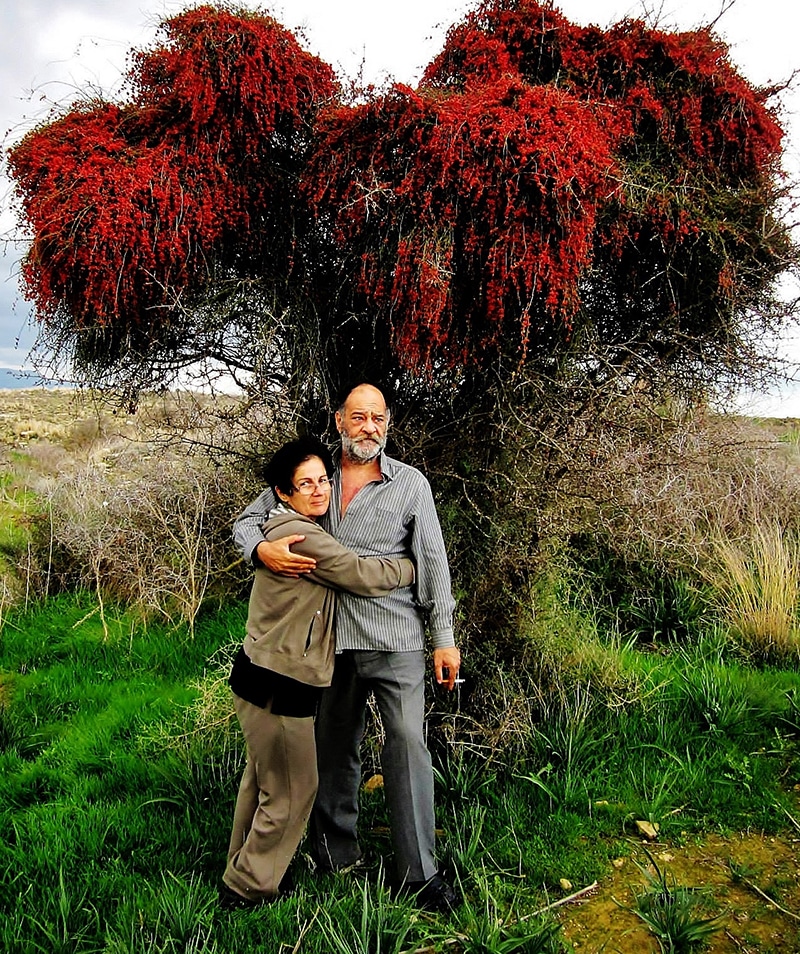
Fani, whom he’d known for years (they were neighbours as kids, then got married in 1985), shared his passion – the couple also owned a pet shop, to pay the bills – though it didn’t trickle down to their children. “It was tough. I can even say they ended up hating it,” admits George. They didn’t have the ‘gene’ – but “because they were kids we had to take them with us, spending all day in the fields. They want nothing to do with it now!”. Instead, the ‘gene’ seems to have skipped a generation: George’s Facebook is full of photos of his 10-year-old grandson (also named George) who – without prompting – has been doing stuff like picking up rocks to find bugs underneath them since he was a toddler. “He’s 10 years old, but he knows everything!” Grandpa proudly shows me a photo of the younger George holding an amusium cristatum, a two-million-year-old clam fossil which the two of them recently unearthed on a trip to Dali.
Love, I suspect, keeps George going, the joy of seeing his mysterious passion confirmed by a new generation – but rage also keeps him going. “You should know one thing,” he tells me darkly: “Right now, in Cyprus, the idiots are in charge”. The idiots are everywhere, from idiots (a.k.a. hunters) who kill animals indiscriminately, for target practice, to well-paid idiots in government who show no interest in helping with his great encyclopaedia. “Idiots tend to stick together,” says George, having studied the subject extensively, “and get rid of all the smart and productive people. That’s what’s happening in Cyprus.” We also talk about the occupied areas – and again, he says gruffly, “I’m not at all political. I’m just against all the idiots”. He has no time for those who refuse to cross, indeed “we have an obligation to go, to get to know our land – and to show by our presence that we’re still here, we haven’t given it up”. He himself knows every road in the north, every nook and cranny; the website includes a definitive “list of towns and villages in occupied Cyprus”.
Ah yes, the website: his great project, though not the only project. George also has an Instagram (cyprus.wildlife.1960), a YouTube channel (the biggest one on Cyprus biodiversity, with over 1,700 videos) and separate blogs devoted to Cyprus mammals and reptiles – but he’s spent the past eight years working on the website, biodiversitycyprus.blogspot.com, especially the modest-looking ‘All About Cyprus’ link which takes you to a cornucopia of… well, everything. Birds and fungi and insects of Cyprus, isopods of Cyprus (one of which he discovered himself, its official Latin name being armadillo Konstantinoui) – but also old mills of Cyprus, caves of Cyprus, picnic sites and monuments and churches and castles and Venetian bridges of Cyprus. “You have to spend many hours,” he explains mildly, “to comprehend what I’ve done.”
It’s a funny thing about evolution, says George Konstantinou: “Everything comes from mistakes”. It’s the freaks of nature that drive a species forward – the giraffe with the long neck who gains an evolutionary advantage when other giraffes can’t reach the high branches in times of drought. George himself was always a bit of a freak, or at least an unusual specimen – yet he’s driving the species forward (the species in question being Cyprius ignoramus), his righteous rage having led to a mania for educating others on Nature and biodiversity.
“I truly believe I’ve changed people in Cyprus, for the better,” he declares, pointing to the Facebook groups he’s formed and the misinformation he’s tried to dispel. “People are beginning to learn. And once this pig-headed old generation dies out – who don’t know anything, and just kill everything – things are going to change!” A grand project, tucked away in a small house in Geri.


.JPG)
.JPG)
.JPG)
.JPG)
.JPG)
.JPG)
.JPG)
.JPG)
.JPG)
.JPG)
.JPG)
.JPG)
.JPG)
.JPG)

.JPG)
.JPG)
.JPG)
.JPG)
.JPG)
.JPG)
.JPG)
.JPG)
.JPG)
.JPG)
.JPG)
.JPG)
.JPG)
.JPG)


